


.jpg&w=256&q=75&dpl=dpl_Gc2H6qw5qz6tftmNLm7EMoaFVtW7)
.jpg&w=256&q=75&dpl=dpl_Gc2H6qw5qz6tftmNLm7EMoaFVtW7)
.webp&w=256&q=75&dpl=dpl_Gc2H6qw5qz6tftmNLm7EMoaFVtW7)
.webp&w=256&q=75&dpl=dpl_Gc2H6qw5qz6tftmNLm7EMoaFVtW7)



Business
Sustainable Business Models: How to Profit
Insights, tutorials, and type notes from the Timeless Type studio.
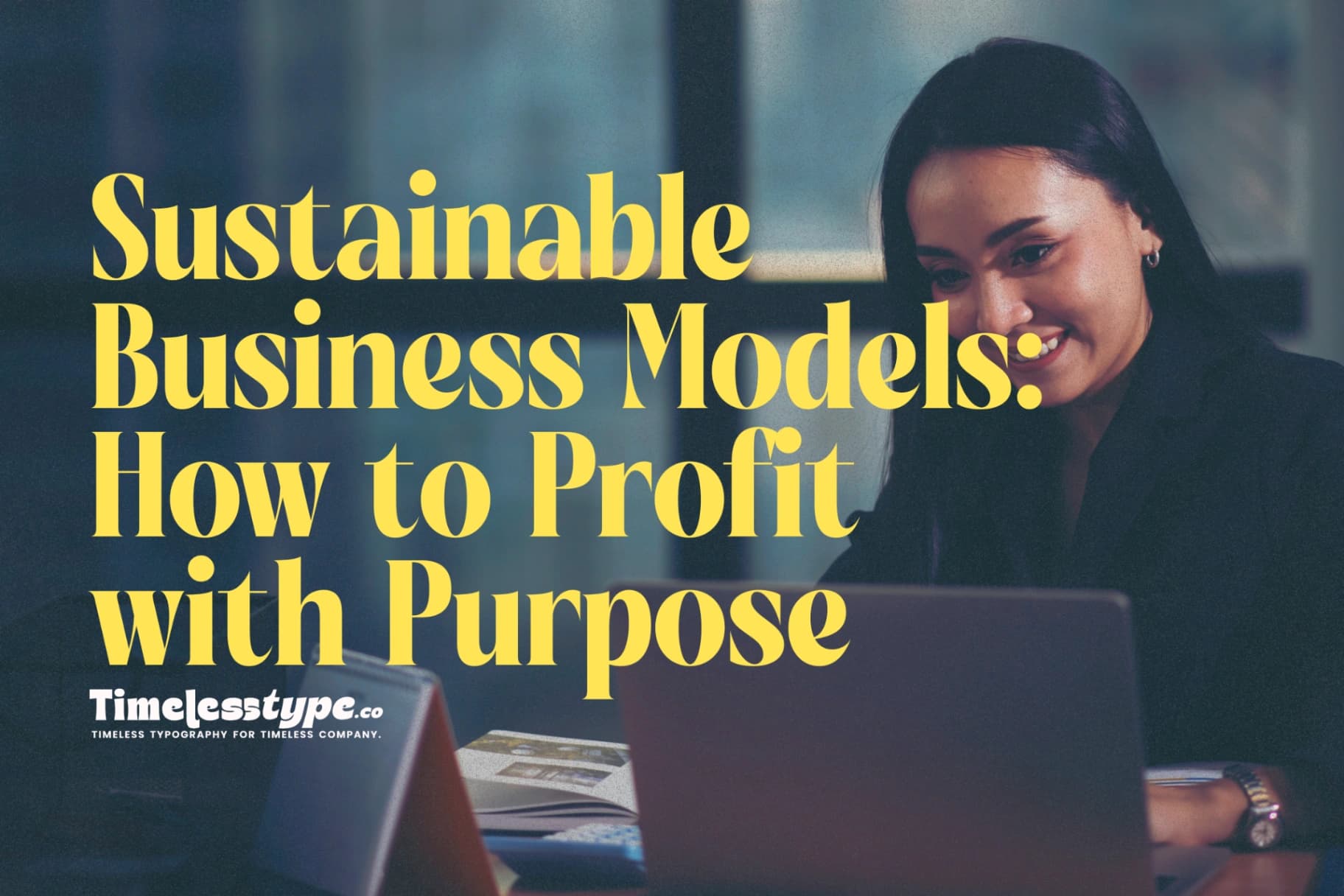
Table of Contents
- 1. The Evolution of Sustainability in Business
- Why the shift?
- 2. What Is a Sustainable Business Model?
- 3. The Business Case for Sustainability
- Proven benefits:
- 4. From Linear to Circular: Rethinking the Business Cycle
- Examples of circular innovation:
- 5. The Role of Technology in Sustainable Business
- How emerging tech drives sustainability:
- 6. Building a Purpose-Driven Value Proposition
- Example:
- 7. The Power of Stakeholder Capitalism
- Stakeholder-driven brands:
- 8. ESG as a Growth Framework
- Why ESG matters:
- 9. Sustainable Supply Chains
- Steps to build a responsible supply chain:
- 10. Social Impact as Core Strategy
- Integrating social responsibility:
- Example:
- 11. Sustainable Finance and Green Investment
- Trends in sustainable finance:
- 12. Energy Efficiency and Carbon Neutrality
- Steps toward a low-carbon business:
- 13. Circular Product Design and Lifecycle Thinking
- Sustainable design principles:
- 14. The Role of Collaboration and Ecosystems
- Partnerships that matter:
- 15. Digital Transformation Meets Sustainability
- Key intersections:
- 16. The Importance of Transparency and Reporting
- Build credibility through:
- 17. Educating Customers and Driving Behavior Change
- Educate through:
- 18. Profitability Through Purpose: Real-World Examples
- Case Studies:
- 19. The Future: Regenerative Business Models
- Characteristics of regenerative models:
- 20. Conclusion: The New Definition of Success
Sustainable Business Models: How to Profit with Purpose
In today’s economy, success isn’t just measured by profit — it’s measured by impact.
Consumers, investors, and employees alike are demanding more than financial returns; they want companies that operate ethically, protect the planet, and create social value.
This shift has given rise to sustainable business models — frameworks that prove profitability and purpose can coexist.
In 2025 and beyond, businesses that balance growth with responsibility won’t just survive — they’ll lead.
Here’s how to build a business model that drives profit with purpose while shaping a better future for all.
1. The Evolution of Sustainability in Business
A decade ago, sustainability was often seen as an optional corporate social responsibility (CSR) initiative — a department or donation strategy rather than a growth engine.
Today, it’s a core business strategy.
Why the shift?
Climate change and resource scarcity have created real business risks.
Consumers expect transparency and ethical sourcing.
Investors are prioritizing Environmental, Social, and Governance (ESG) performance.
Employees want to work for companies with meaning.
Sustainability has moved from a moral imperative to a market advantage.
Companies that embrace it early are defining the rules of the next economy.
2. What Is a Sustainable Business Model?
A sustainable business model creates long-term value for both the company and society.
It integrates environmental stewardship, social responsibility, and economic performance — the triple bottom line of:
People – respecting communities and fair labor practices.
Planet – minimizing ecological impact.
Profit – ensuring financial health and innovation.
In short, a sustainable business isn’t just about doing less harm — it’s about doing more good, profitably.
3. The Business Case for Sustainability
Sustainability isn’t just ethical — it’s economically smart.
Proven benefits:
Cost savings: Energy efficiency, waste reduction, and optimized logistics reduce expenses.
Customer loyalty: Conscious consumers choose brands that align with their values.
Access to capital: ESG-compliant companies attract more investment.
Talent retention: Employees are more engaged when they believe in their company’s purpose.
Resilience: Sustainable operations are less vulnerable to regulation, supply shocks, or public backlash.
In other words, doing good is no longer a trade-off — it’s a competitive advantage.
4. From Linear to Circular: Rethinking the Business Cycle
Traditional business models are linear — take, make, waste.
Sustainable business models are circular — design, reuse, regenerate.
Examples of circular innovation:
Patagonia: Repairs and recycles clothing instead of discarding it.
IKEA: Introduced furniture buy-back programs.
Loop: Delivers consumer goods in reusable containers.
Circular models close the loop — maximizing value from every resource and minimizing waste.
They don’t just sustain — they regenerate.
5. The Role of Technology in Sustainable Business
Technology is the bridge between purpose and profit.
How emerging tech drives sustainability:
AI and data analytics: Optimize energy, waste, and supply chain efficiency.
IoT (Internet of Things): Tracks real-time environmental impact.
Blockchain: Ensures transparency and traceability in ethical sourcing.
Clean energy innovations: Solar, wind, and green hydrogen lower carbon footprints.
In 2025, sustainability and technology are no longer separate paths — they’re the same road.
6. Building a Purpose-Driven Value Proposition
To integrate sustainability, start with your value proposition — what you offer and why it matters.
Ask yourself:
Does your product solve a real social or environmental challenge?
Is your supply chain ethical and transparent?
Can your business thrive without exploiting people or the planet?
Example:
Beyond Meat didn’t just sell food — it sold a sustainable alternative to meat production, appealing to both environmentalists and health-conscious consumers.
Purpose-driven innovation creates new markets and loyal communities.
7. The Power of Stakeholder Capitalism
The old rule of capitalism said: maximize shareholder value.
The new rule says: maximize stakeholder value — customers, employees, communities, and investors alike.
Companies are now judged not only by their profits but by how they make them.
Stakeholder-driven brands:
Unilever: Measures success by “sustainable living brands” that outperform traditional products.
Microsoft: Committed to becoming carbon-negative by 2030.
Ben & Jerry’s: Advocates for social justice while growing global market share.
When businesses consider all stakeholders, they gain trust, loyalty, and longevity.
8. ESG as a Growth Framework
Environmental, Social, and Governance (ESG) metrics are becoming the new standard for business performance.
Why ESG matters:
Investors use ESG ratings to assess risk and sustainability.
Governments and regulators demand greater transparency.
Customers reward ESG-driven companies with long-term loyalty.
In 2025, integrating ESG is no longer optional — it’s how businesses earn legitimacy and capital.
9. Sustainable Supply Chains
Sustainability doesn’t stop at your office door — it extends through your entire supply chain.
Steps to build a responsible supply chain:
Source ethically: Partner with fair-trade and eco-certified suppliers.
Audit regularly: Monitor for human rights and environmental compliance.
Localize production: Reduce emissions by minimizing long-distance shipping.
Use digital tools: Blockchain and AI for traceability and efficiency.
Transparency builds trust, and trust drives profitability.
10. Social Impact as Core Strategy
Social impact isn’t just philanthropy — it’s smart strategy.
Integrating social responsibility:
Offer fair wages and inclusive hiring.
Support local communities through partnerships.
Develop products that improve lives (health, education, accessibility).
Example:
TOMS Shoes evolved from “buy one, give one” to investing in community-led initiatives — turning generosity into a sustainable impact model.
Purpose amplifies profits when it’s authentic and measurable.
11. Sustainable Finance and Green Investment
Money is flowing toward sustainability — and fast.
Trends in sustainable finance:
Green bonds: Funding eco-friendly projects.
Impact investing: Investors prioritize measurable positive outcomes.
ESG funds: Growing at double-digit rates globally.
By aligning your model with sustainability, you attract investors who seek not just returns, but responsible returns.
12. Energy Efficiency and Carbon Neutrality
Reducing your carbon footprint isn’t just about image — it’s about long-term savings and compliance.
Steps toward a low-carbon business:
Audit energy usage and switch to renewables.
Electrify fleets and use smart logistics.
Adopt energy-efficient appliances and facilities.
Offset remaining emissions through verified carbon credits.
Brands like Apple and Google are carbon-neutral — but now, even small businesses can access affordable clean tech.
Sustainability scales down as easily as it scales up.
13. Circular Product Design and Lifecycle Thinking
Design with the end in mind.
Sustainable design principles:
Use durable, recyclable materials.
Enable product repairability and resale.
Build modular systems for upgrade, not replacement.
This model encourages customers to buy smarter, not faster, creating long-term relationships and recurring revenue instead of waste.
14. The Role of Collaboration and Ecosystems
Sustainability can’t be achieved alone — it thrives on collaboration.
Partnerships that matter:
Join industry coalitions (like the UN Global Compact).
Partner with local communities for shared growth.
Collaborate with suppliers and competitors for circular ecosystems.
When purpose becomes a shared mission, impact multiplies.
15. Digital Transformation Meets Sustainability
Digital transformation and sustainability are converging goals.
The technologies that make businesses faster also make them greener.
Key intersections:
AI predicts resource usage and reduces waste.
Cloud computing reduces on-site energy consumption.
Remote work minimizes carbon emissions.
Smart digital systems create not only efficiency but accountability.
16. The Importance of Transparency and Reporting
Sustainability claims mean little without proof.
Build credibility through:
Public sustainability reports.
Third-party certifications (B Corp, Fair Trade, ISO 14001).
Open data sharing about sourcing and impact.
Transparency builds brand integrity — the most valuable asset in a skeptical world.
17. Educating Customers and Driving Behavior Change
Consumers want to make sustainable choices but need guidance.
Educate through:
Product labeling (carbon footprint, ethical sourcing).
Content marketing that informs and empowers.
Loyalty programs rewarding sustainable purchases.
A business that teaches customers to live better creates advocates, not just buyers.
18. Profitability Through Purpose: Real-World Examples
Case Studies:
Tesla: Made sustainability aspirational, not niche — proving green tech can be profitable.
Patagonia: Encourages customers to buy less, yet grows annually due to trust and loyalty.
Unilever: Sustainable Living brands account for over 70% of its growth.
Purpose-driven companies don’t sacrifice profit — they redefine it.
19. The Future: Regenerative Business Models
The next step beyond sustainability is regeneration — giving back more than we take.
Characteristics of regenerative models:
Restoring ecosystems instead of just reducing damage.
Empowering communities economically and socially.
Designing closed-loop production systems.
Businesses that embrace regeneration will become the architects of a thriving future economy.
20. Conclusion: The New Definition of Success
In the 21st century, the most successful companies won’t be those that extract the most value —
they’ll be those that create the most value for all.
Sustainability is no longer a marketing strategy — it’s a business imperative.
Profit with purpose is the new bottom line, where doing good and doing well are the same goal.
Every business — no matter its size — can be part of this transformation.
Because the future of business isn’t just about growth;
it’s about growing responsibly.
Related
Tags
Browse similar work by purpose and style.
.webp&w=1920&q=75&dpl=dpl_Gc2H6qw5qz6tftmNLm7EMoaFVtW7)
.webp&w=1920&q=75&dpl=dpl_Gc2H6qw5qz6tftmNLm7EMoaFVtW7)
.webp&w=1920&q=75&dpl=dpl_Gc2H6qw5qz6tftmNLm7EMoaFVtW7)
.webp&w=1920&q=75&dpl=dpl_Gc2H6qw5qz6tftmNLm7EMoaFVtW7)
.webp&w=1920&q=75&dpl=dpl_Gc2H6qw5qz6tftmNLm7EMoaFVtW7)
.webp&w=1920&q=75&dpl=dpl_Gc2H6qw5qz6tftmNLm7EMoaFVtW7)
.webp&w=1920&q=75&dpl=dpl_Gc2H6qw5qz6tftmNLm7EMoaFVtW7)