








Blockchain: More Than Just Cryptocurrency
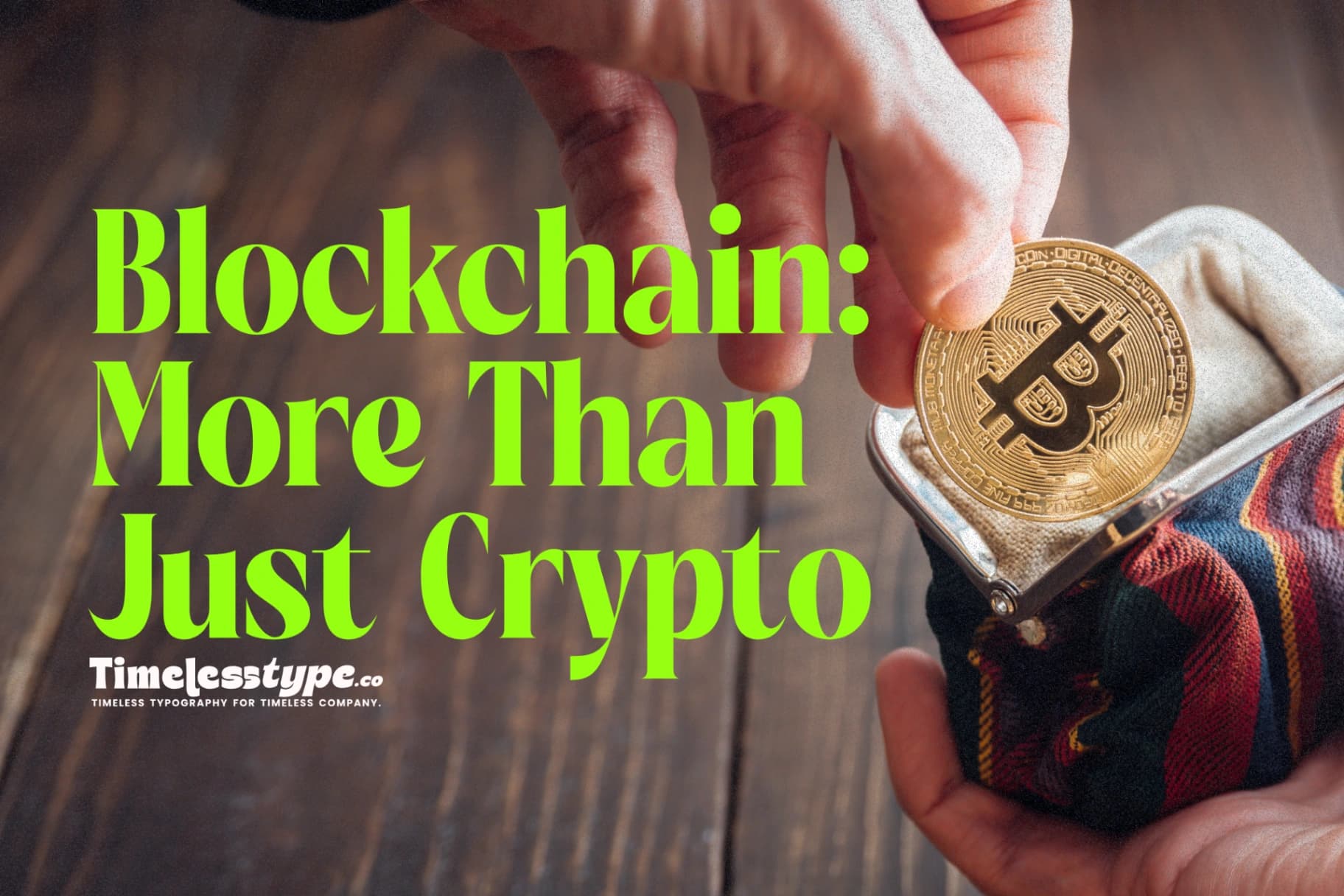
Table of Contents
- I. The Trust Machine: Understanding the Tech (Without the Jargon)
- II. Supply Chain Transparency: From Farm to Table
- III. Smart Contracts: The End of "The Middleman"
- IV. Identity Management: Reclaiming Digital Sovereignty
- V. Healthcare: Breaking Down Data Silos
- VI. Tokenization: The Liquidity of Everything
- VII. Beyond the Hype: NFTs and Digital Ownership
- VIII. The Challenges Ahead: Why We Aren't There Yet
- IX. Conclusion: The Invisible Infrastructure
Blockchain: More Than Just Cryptocurrency
In the popular imagination, the word "blockchain" is inextricably linked to "Bitcoin." For the better part of a decade, the two terms have been used interchangeably in news headlines, dinner table conversations, and financial forums. When the price of cryptocurrency skyrockets, blockchain is hailed as the future; when the market crashes, blockchain is dismissed as a speculative bubble.
This conflation is a fundamental misunderstanding.
To say that blockchain is just about cryptocurrency is like saying the internet is just about email. Email was the first "killer app" of the internet—the utility that drove early adoption—but it was merely the tip of the iceberg. Beneath the surface lay a foundational technology that would eventually birth social media, streaming, e-commerce, and the cloud.
Similarly, cryptocurrency is merely the first application of blockchain. The underlying technology—the "distributed ledger"—is something far more profound. It is a shift in how we store data, how we verify truth, and how we establish trust in a digital world. As we move deeper into the 2020s, blockchain is quietly decoupling from the volatility of the crypto markets and finding its home in the backend of the global economy.
This article explores the true potential of blockchain technology, stripping away the hype to reveal a tool that is poised to revolutionize supply chains, healthcare, governance, and the very nature of ownership.
I. The Trust Machine: Understanding the Tech (Without the Jargon)
To understand why blockchain matters, we must first understand the problem it solves: The Problem of Trust.
For centuries, commerce and cooperation have relied on centralized intermediaries to establish trust. If you want to send money to a friend in another country, you don't hand them cash; you use a bank. You trust the bank to verify that you have the money, to deduct it from your account, and to add it to your friend's account. The bank holds the "Master Ledger."
But centralized ledgers have weaknesses. They can be hacked. They can be manipulated by corrupt insiders. They are often slow, expensive, and opaque.
Blockchain solves this by creating a Decentralized Ledger.
Imagine a Google Document. If you share a Google Doc with 100 people, everyone can see the changes in real-time. If one person tries to delete a paragraph, everyone else sees it. Now, imagine that this document is "immutable"—meaning once a line is written, it can never be erased or changed, only added to.
In technical terms:
Decentralization: The data doesn't live on one server; it lives on thousands of computers (nodes) simultaneously.
Transparency: Anyone with permission can view the ledger.
Immutability: Using complex cryptography, once a "block" of data is filled and added to the "chain," it is mathematically sealed. To hack it, you wouldn't need to hack one bank; you would need to hack thousands of computers at the exact same instant—a feat currently impossible for even the most powerful supercomputers.
This creates a system where trust is established by code, not by institutions. It is a "Trustless" system—not because you don't trust it, but because you don't need to trust a human third party for it to work.
II. Supply Chain Transparency: From Farm to Table
One of the most immediate and impactful applications of blockchain is in supply chain management. The journey of a product—from raw material to finished good—is often a black box.
Consider the food industry. If a bacterial outbreak (like E. coli) occurs in lettuce, it often takes weeks for retailers to trace the source. In the meantime, millions of dollars of safe produce are destroyed out of caution, and consumers get sick.
The Blockchain Solution:
Major retailers like Walmart and technological giants like IBM have collaborated on blockchain solutions (such as the IBM Food Trust). In this system, every step of the lettuce’s journey is recorded on a blockchain.
Step 1: The farmer scans the batch.
Step 2: The truck driver scans the pallet.
Step 3: The warehouse scans the arrival.
Step 4: The supermarket scans the shelf placement.
Because the record is immutable and shared, a retailer can trace a head of lettuce back to the specific farm in seconds, not weeks.
This extends beyond food.
Luxury Goods: Brands like LVMH are using blockchain to certify the authenticity of luxury handbags and watches, eliminating the counterfeit market. A customer can scan a QR code and see the entire history of the leather and craftsmanship.
Ethical Sourcing: Consumers can verify if the diamonds in their jewelry are conflict-free or if the cobalt in their electric vehicle batteries was mined without child labor. Blockchain brings radical transparency to global logistics.
III. Smart Contracts: The End of "The Middleman"
Perhaps the most disruptive feature of blockchain is the "Smart Contract."
A smart contract is a self-executing contract with the terms of the agreement directly written into lines of code. The code controls the execution, and transactions are trackable and irreversible.
Think of a vending machine. A vending machine is a primitive smart contract. You input value ($2.00) + selection (Coke) = The machine releases the soda. You do not need a cashier (middleman) to verify the transaction. The machine does it automatically.
Blockchain allows this logic to be applied to complex industries:
1. Insurance
Currently, if your flight is cancelled, you have to file a claim, call an agent, send proof, and wait weeks for a check.
With a flight insurance smart contract: The blockchain is connected to flight data. As soon as the flight is officially marked "Cancelled" in the system, the smart contract triggers. It automatically releases the funds to your digital wallet instantly. No paperwork, no arguments, no delay.
2. Real Estate
Buying a house involves lawyers, escrow agents, title companies, and notaries, all taking a cut and slowing the process. Smart contracts could hold the deed and the funds. Once the payment is verified and the inspection clears (digitally signed), the ownership transfers automatically.
3. Intellectual Property and Royalties
Musicians and writers often struggle to get paid fairly. Streaming services and record labels act as opaque middlemen. With blockchain, a song could have a smart contract attached to it. Every time it is played, a fraction of a cent is automatically sent to the artist's wallet, instantly and transparently.
IV. Identity Management: Reclaiming Digital Sovereignty
We are currently living through a digital identity crisis. Our personal data—social security numbers, passwords, medical history—is stored in centralized "honeypots" (like Equifax or Facebook servers) which are prime targets for hackers. Furthermore, billions of people in the developing world lack official documentation (birth certificates, passports), effectively locking them out of the global economy.
Blockchain proposes a model called Self-Sovereign Identity (SSI).
In this model, users control their own identity. Instead of giving Google your password, or giving a bar your physical driver's license (which reveals your address and exact age), you hold your credentials in a secure digital wallet.
When you need to prove you are over 21 to enter a bar, the bouncer scans your app. The blockchain verifies the "True/False" query: Is this user over 21? The system returns a "Yes" without ever revealing your name, address, or exact date of birth.
This has massive implications for:
Refugees: People fleeing conflict often lose their papers. A blockchain-based identity could travel with them, allowing them to prove their education and medical history in a new country.
Voting: Democracy relies on trust. Blockchain could enable secure, mobile voting. Because each vote is a transaction on the ledger, it cannot be deleted or altered. Citizens could verify that their vote was counted, and the final tally would be mathematically auditable by anyone, potentially ending accusations of voter fraud.
V. Healthcare: Breaking Down Data Silos
The healthcare industry is plagued by fragmentation. If you see a specialist, they often don't have access to the records from your primary care physician. This leads to redundant tests, dangerous drug interactions, and administrative bloat.
Blockchain can create a Unified Patient Record.
Imagine a ledger that contains your entire medical history—immunizations, allergies, surgeries, prescriptions.
Privacy: You own the "key" to this record.
Interoperability: When you see a new doctor, you grant them temporary access to your blockchain record. They see exactly what they need to see, and nothing else.
Research: Patients could choose to anonymously "lease" their medical data to pharmaceutical researchers for tokenized rewards, accelerating drug discovery while maintaining privacy.
Estonia is a pioneer here. The country has already moved almost all of its public health records onto a blockchain-based system (KSI), securing the health data of over a million citizens.
VI. Tokenization: The Liquidity of Everything
One of the more complex but economically significant applications of blockchain is Asset Tokenization.
Tokenization is the process of representing ownership of a real-world asset as a digital token on a blockchain. This changes how we invest.
Take a $10 million painting by Picasso. Currently, only the ultra-wealthy can own it. It is an "illiquid" asset—it is hard to sell quickly.
With tokenization, that painting can be divided into 10,000 digital tokens, each worth $1,000.
An average investor can own 1% of a Picasso.
If the value of the painting goes up, the value of the token goes up.
The owner can sell their tokens on a global market instantly, just like selling a stock.
This applies to real estate (owning a fraction of a skyscraper), vintage cars, or even commercial forests. It democratizes access to wealth-creation assets that were previously gated behind high entry costs.
VII. Beyond the Hype: NFTs and Digital Ownership
We must address the elephant in the room: NFTs (Non-Fungible Tokens).
In 2021, the world was bewildered by news of digital cartoons of monkeys selling for millions of dollars. This speculative bubble caused many to dismiss NFTs as a scam. However, looking past the "digital art" craze, the underlying technology is revolutionary.
An NFT is simply a digital certificate of authenticity. In a digital world where anything can be "copy-pasted" (a JPEG, an MP3), NFTs introduce the concept of Digital Scarcity.
The future utility of NFTs looks like this:
Education: Diplomas and degrees issued as NFTs. A potential employer can verify your degree instantly on the blockchain; you cannot fake a Harvard degree.
Real Estate Deeds: The title to your house is an NFT.
Event Ticketing: Ticketmaster is already exploring this. If a concert ticket is an NFT, scalpers cannot create fake tickets. Furthermore, the smart contract can dictate that the artist gets a 10% royalty every time the ticket is resold on the secondary market.
VIII. The Challenges Ahead: Why We Aren't There Yet
If blockchain is so great, why isn't it running the world yet? We are in the "dial-up internet" phase of blockchain. There are significant hurdles to overcome.
1. Scalability
This is the biggest bottleneck. Traditional payment processors (like Visa) can handle roughly 24,000 transactions per second. Bitcoin can handle about 7. Ethereum, roughly 15-30 (though this is improving with Layer 2 solutions). For blockchain to handle global supply chains or stock markets, it needs to process millions of transactions per second without crashing or becoming prohibitively expensive.
2. Energy Consumption
Early blockchains (like Bitcoin) use a consensus mechanism called "Proof of Work," which requires massive amounts of electricity to secure the network. However, the industry is rapidly shifting. Ethereum recently moved to "Proof of Stake," reducing its energy consumption by 99.95%. The future of blockchain must be green to be adopted by ESG-conscious corporations.
3. Regulation
Governments are struggling to categorize blockchain. Is a token a security? A currency? A property? Until there is clear legal clarity, large institutions are hesitant to fully dive in.
4. User Experience (UX)
Currently, using blockchain requires managing "private keys," "wallets," and "gas fees." It is terrifyingly easy for a user to lose their password and lose their life savings forever. For mass adoption, the "blockchain" part needs to become invisible. It needs to be as easy as logging into Apple ID.
IX. Conclusion: The Invisible Infrastructure
The greatest technologies are the ones that disappear.
We do not talk about "TCP/IP" or "SMTP" anymore; we just talk about browsing the web or sending an email. We do not think about the complex combustion engine when we drive to the store.
This is the future of blockchain.
By 2030 or 2035, we likely won't use the word "blockchain" very often.
We will just know that our food is safe.
We will just know that our vote was counted.
We will just know that the money we sent to our family arrived instantly.
We will just know that our medical records are secure.
Blockchain is not merely a casino for crypto traders. It is a new architectural layer for the internet. The first era of the internet (Web1 and Web2) was about the transfer of Information. The next era (Web3), powered by blockchain, is about the transfer of Value and Truth.
We are currently witnessing the messy, chaotic construction phase of this new infrastructure. But once the foundation is set, the world that is built on top of it will be more transparent, more efficient, and more equitable. The revolution is not in the price of the coin; the revolution is in the code.
Use Arrow Up and Arrow Down to select a turn, Enter to jump to it, and Escape to return to the chat.
.webp&w=3840&q=75&dpl=dpl_3WFG66fYZ4jS6JATNdYhDAcw7pMB)
.webp&w=3840&q=75&dpl=dpl_3WFG66fYZ4jS6JATNdYhDAcw7pMB)
.webp&w=3840&q=75&dpl=dpl_3WFG66fYZ4jS6JATNdYhDAcw7pMB)
.webp&w=3840&q=75&dpl=dpl_3WFG66fYZ4jS6JATNdYhDAcw7pMB)
.webp&w=3840&q=75&dpl=dpl_3WFG66fYZ4jS6JATNdYhDAcw7pMB)
.webp&w=3840&q=75&dpl=dpl_3WFG66fYZ4jS6JATNdYhDAcw7pMB)
.webp&w=3840&q=75&dpl=dpl_3WFG66fYZ4jS6JATNdYhDAcw7pMB)
.webp&w=3840&q=75&dpl=dpl_3WFG66fYZ4jS6JATNdYhDAcw7pMB)