.jpg&w=256&q=75&dpl=dpl_H7xZisjieYncx72kKJbBTqqn2Q5s)
.jpg&w=256&q=75&dpl=dpl_H7xZisjieYncx72kKJbBTqqn2Q5s)
.webp&w=256&q=75&dpl=dpl_H7xZisjieYncx72kKJbBTqqn2Q5s)
.webp&w=256&q=75&dpl=dpl_H7xZisjieYncx72kKJbBTqqn2Q5s)

Inspiration
Why Comparison Kills Creativity and How to Stop It
Insights, tutorials, and type notes from the Timeless Type studio.
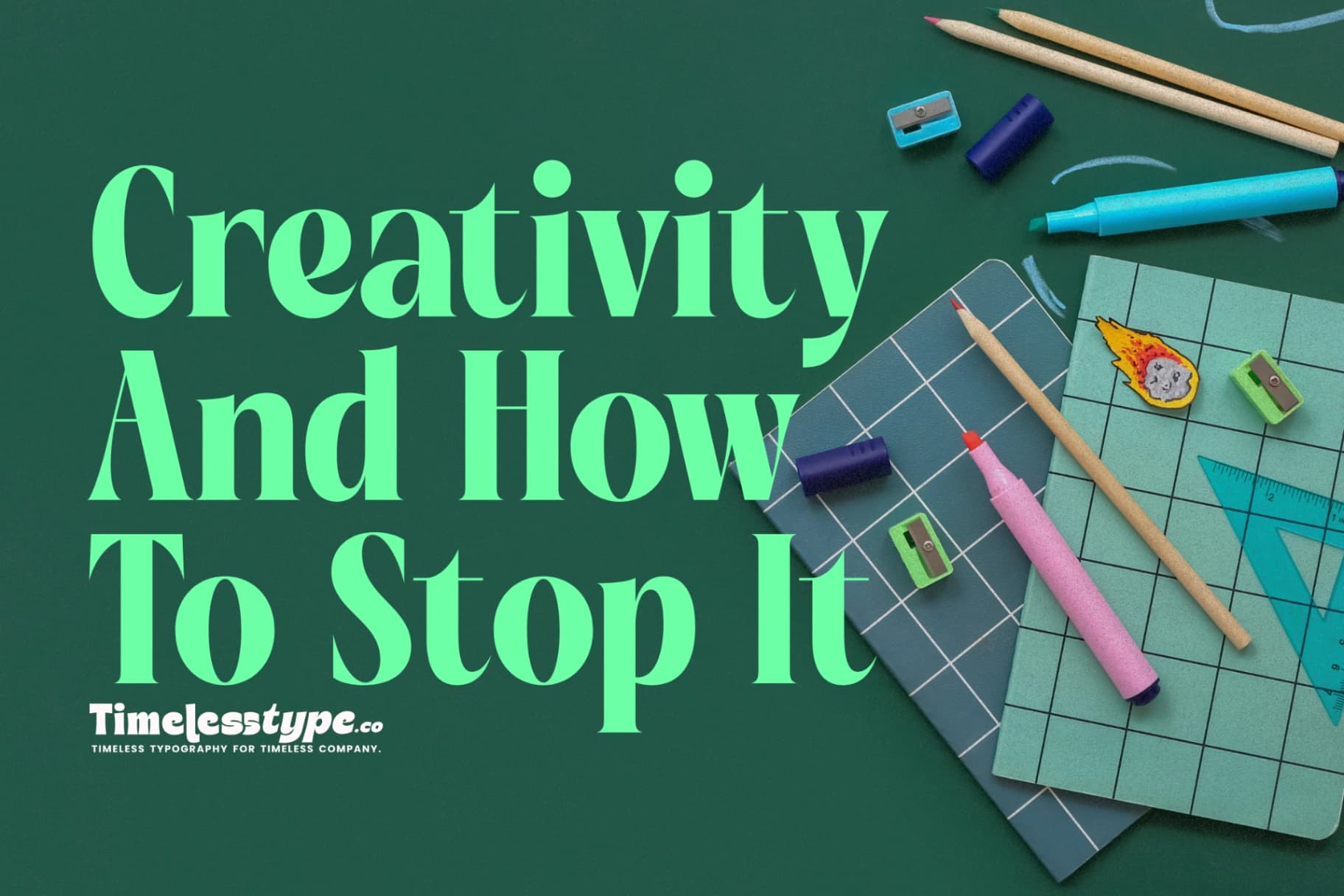
Table of Contents
- Comparison Shifts Focus From Expression to Evaluation
- The Brain Interprets Comparison as Threat
- Comparison Creates the Illusion of Objectivity
- Comparison Turns Inspiration Into Intimidation
- Creativity Needs Permission to Be Bad
- Comparison Accelerates Impostor Syndrome
- Comparison Replaces Internal Motivation With External Metrics
- Why Social Media Intensifies the Problem
- Comparison Shrinks Creative Range
- Comparison Turns Peers Into Competitors
- The Myth That Comparison Keeps You Sharp
- How Comparison Distorts Time
- Why Stopping Comparison Completely Is Unrealistic
- Shift From Comparison to Observation
- Limit Input During Creative Phases
- Build Self-Referenced Metrics
- Separate Learning Mode From Creating Mode
- Reconnect With Why You Create
- Accept That Creativity Is Uneven
- Protect the Early Stages of Ideas
- Redefine Success for Creative Work
- Creativity Requires Psychological Safety
- Long-Term Creativity Depends on Enjoyment
- Final Reflection
Why Comparison Kills Creativity and How to Stop It
Comparison feels harmless at first. You scroll, observe, measure, and tell yourself you’re just “staying informed” or “learning from others.” But over time, comparison quietly rewires how creativity works in your mind.
Instead of curiosity, you feel pressure.
Instead of exploration, you feel judgment.
Instead of creating, you hesitate.
Creativity doesn’t die from lack of talent. It dies from constant comparison.
This article explores why comparison is so destructive to creative work, how it subtly reshapes motivation and self-trust, and what actually helps you step out of the comparison loop without isolating yourself from the world.
Comparison Shifts Focus From Expression to Evaluation
Creativity begins with expression—an internal impulse to explore, build, or communicate something meaningful.
Comparison interrupts that process.
When you compare, your focus shifts from:
“What do I want to make?”
to
“How does this measure up?”
This shift turns creativity into performance.
Instead of creating from curiosity, you start creating for approval, relevance, or validation. The work becomes cautious. Risk decreases. Originality fades.
Creativity thrives in freedom. Comparison introduces surveillance.
The Brain Interprets Comparison as Threat
Comparison isn’t neutral. Neurologically, it often registers as threat.
When you compare yourself to others:
The brain activates self-protection
Fear of inadequacy increases
Risk-taking decreases
Perfectionism rises
Creativity requires psychological safety. Comparison removes it.
A mind trying to protect its status rarely experiments.
Comparison Creates the Illusion of Objectivity
Comparison feels rational:
“They’re better.”
“They’re ahead.”
“They figured it out faster.”
But what you’re comparing is incomplete.
You see:
Highlights, not process
Finished work, not drafts
Confidence, not doubt
Outcomes, not context
Creativity collapses when you judge your beginning against someone else’s middle.
Comparison Turns Inspiration Into Intimidation
At first, comparison masquerades as inspiration.
But inspiration becomes intimidation when:
You feel smaller instead of energized
You hesitate instead of act
You doubt instead of explore
Once comparison creates self-doubt, it stops motivating and starts paralyzing.
Creative energy drains into self-monitoring.
Creativity Needs Permission to Be Bad
Every creative process includes:
Rough drafts
Bad ideas
Failed experiments
Awkward attempts
Comparison removes permission to be bad.
When you constantly compare, you feel pressure to be impressive immediately. This kills iteration—the core of creative development.
No one creates well without first creating badly.
Comparison Accelerates Impostor Syndrome
Comparison fuels impostor syndrome by amplifying perceived gaps.
You start thinking:
“Everyone else knows what they’re doing.”
“I’m behind.”
“I don’t belong here.”
Impostor syndrome doesn’t come from incompetence—it comes from visibility without context.
Creativity slows when self-trust erodes.
Comparison Replaces Internal Motivation With External Metrics
Creative work is sustained by intrinsic motivation:
Curiosity
Enjoyment
Meaning
Comparison introduces extrinsic metrics:
Likes
Followers
Revenue
Recognition
Once creativity depends on external validation, it becomes fragile.
External metrics fluctuate. Creativity needs stability.
Why Social Media Intensifies the Problem
Social platforms are comparison engines by design.
They:
Rank content
Highlight popularity
Reward speed and volume
Promote trends
This environment encourages imitation over exploration.
Creativity becomes reactive instead of reflective.
You start chasing what works instead of discovering what’s true to you.
Comparison Shrinks Creative Range
When you compare too much, you subconsciously limit yourself to what’s already accepted.
You avoid:
Unpopular ideas
Unfamiliar styles
Slower processes
Personal themes
This creates safe but generic work.
Originality requires stepping outside what’s currently validated.
Comparison Turns Peers Into Competitors
Comparison reframes peers as threats.
Instead of:
Learning together
Sharing ideas
Supporting growth
You feel:
Defensive
Guarded
Resentful
Creativity thrives in community—but comparison corrodes it.
The Myth That Comparison Keeps You Sharp
Some people believe comparison is necessary to improve.
In reality:
Comparison can inform standards
But constant comparison erodes confidence
Growth requires feedback, not judgment.
Feedback is specific and actionable.
Comparison is vague and emotional.
How Comparison Distorts Time
Comparison makes timelines feel urgent.
You start believing:
You’re late
You missed the moment
You should be further
Creativity doesn’t follow linear timelines.
Rushing creativity produces shallow work.
Why Stopping Comparison Completely Is Unrealistic
Comparison is human.
The goal is not elimination—it’s regulation.
Trying to avoid comparison entirely often leads to:
Isolation
Denial
Rebound behavior
The goal is to reduce its influence—not pretend it won’t happen.
Shift From Comparison to Observation
Observation is neutral. Comparison is evaluative.
Observation asks:
“What techniques are they using?”
“What resonates with me?”
“What could I learn?”
Comparison asks:
“Am I better or worse?”
One builds skill. The other builds anxiety.
Limit Input During Creative Phases
Creativity needs quiet.
During creation:
Reduce scrolling
Avoid metrics
Limit exposure to similar work
Input is useful—but too much input overwhelms originality.
Create first. Consume later.
Build Self-Referenced Metrics
Instead of measuring yourself against others, measure against:
Your past work
Your consistency
Your learning curve
Your depth of engagement
Progress becomes visible when the reference point is internal.
Separate Learning Mode From Creating Mode
Learning mode:
Study others
Analyze techniques
Gather ideas
Creating mode:
Focus inward
Suspend judgment
Experiment freely
Mixing these modes leads to comparison paralysis.
Structure protects creativity.
Reconnect With Why You Create
Comparison obscures purpose.
Ask:
Why did I start?
What do I enjoy making?
What feels honest to explore?
Creativity fueled by personal meaning is resilient.
Accept That Creativity Is Uneven
Some days are good. Some aren’t.
Comparison assumes constant performance.
Creativity works in cycles:
Output
Reflection
Recovery
Uneven output is not failure—it’s normal.
Protect the Early Stages of Ideas
Ideas are fragile at birth.
Comparison too early:
Kills confidence
Alters direction
Forces premature polish
Protect ideas until they’re strong enough to stand.
Redefine Success for Creative Work
If success equals popularity, comparison is inevitable.
If success equals:
Completion
Honesty
Growth
Sustainability
Comparison loses power.
Your definition of success determines your creative freedom.
Creativity Requires Psychological Safety
Safety comes from:
Self-compassion
Low stakes
Permission to explore
Comparison removes safety.
Create environments—mental and physical—where judgment is minimal.
Long-Term Creativity Depends on Enjoyment
People who last creatively don’t win comparison games.
They enjoy the process.
Enjoyment sustains effort when recognition fades.
Final Reflection
Comparison kills creativity not because it informs—but because it intimidates.
It replaces curiosity with judgment.
Exploration with performance.
Expression with approval-seeking.
You don’t stop comparison by isolating yourself.
You stop it by changing how much authority it has.
Observe instead of evaluate.
Create before consuming.
Measure progress internally.
Protect your process.
Creativity doesn’t need you to be the best.
It needs you to be present, honest, and willing to explore.
The moment you stop asking how you compare—
you give creativity room to breathe again.
Related
Tags
Browse similar work by purpose and style.
.webp&w=1920&q=75&dpl=dpl_H7xZisjieYncx72kKJbBTqqn2Q5s)
.webp&w=1920&q=75&dpl=dpl_H7xZisjieYncx72kKJbBTqqn2Q5s)
.webp&w=1920&q=75&dpl=dpl_H7xZisjieYncx72kKJbBTqqn2Q5s)
.webp&w=1920&q=75&dpl=dpl_H7xZisjieYncx72kKJbBTqqn2Q5s)
.webp&w=1920&q=75&dpl=dpl_H7xZisjieYncx72kKJbBTqqn2Q5s)
.webp&w=1920&q=75&dpl=dpl_H7xZisjieYncx72kKJbBTqqn2Q5s)
.webp&w=1920&q=75&dpl=dpl_H7xZisjieYncx72kKJbBTqqn2Q5s)