



.jpg&w=256&q=75&dpl=dpl_H7xZisjieYncx72kKJbBTqqn2Q5s)
.jpg&w=256&q=75&dpl=dpl_H7xZisjieYncx72kKJbBTqqn2Q5s)
.webp&w=256&q=75&dpl=dpl_H7xZisjieYncx72kKJbBTqqn2Q5s)
.webp&w=256&q=75&dpl=dpl_H7xZisjieYncx72kKJbBTqqn2Q5s)





Technology
Top 10 Technology Trends That Will Shape the Future in 2025
Insights, tutorials, and type notes from the Timeless Type studio.
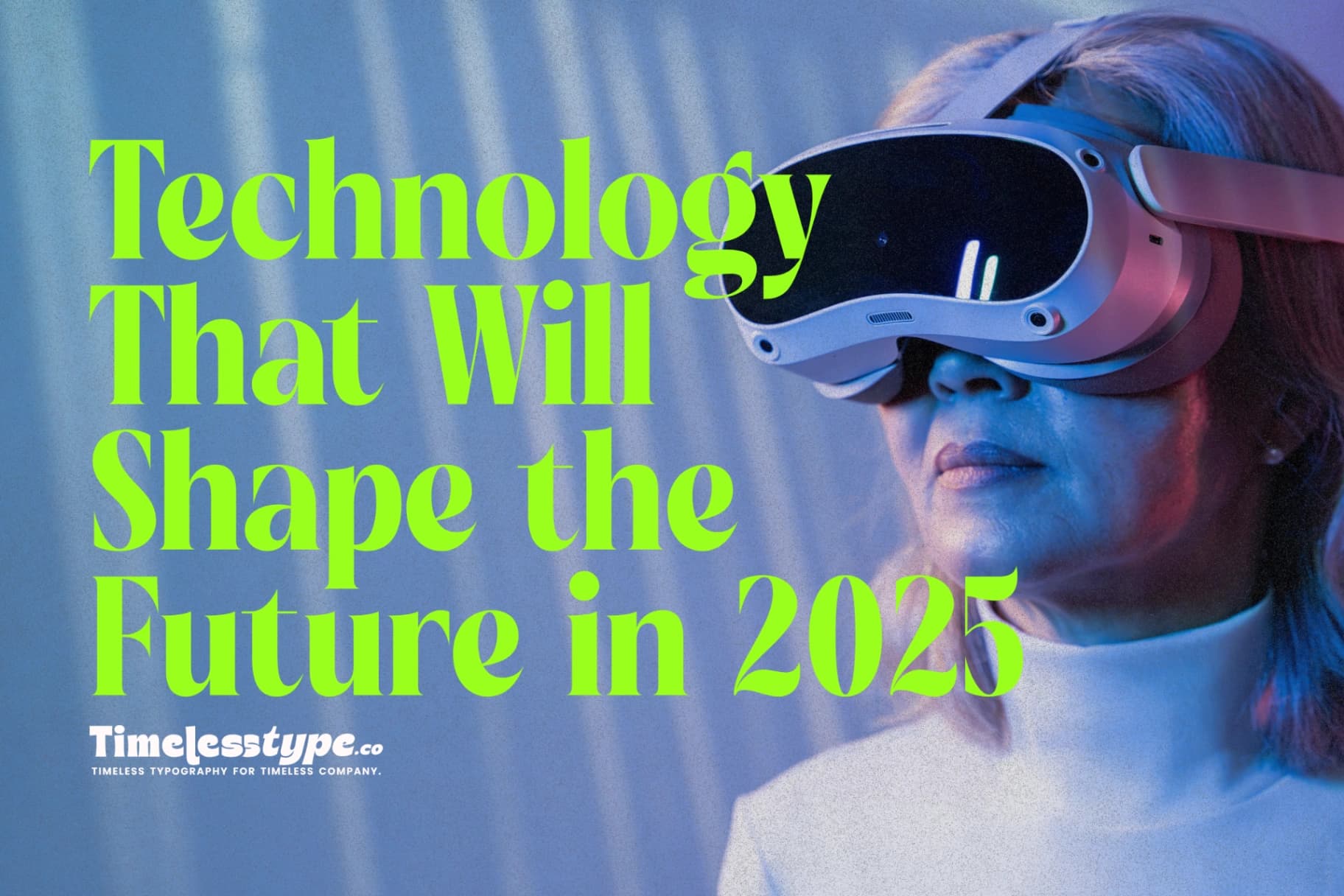
Table of Contents
- 1. Artificial Intelligence Goes Mainstream — Responsibly
- Key shifts:
- 2. Quantum Computing Breaks into Commercial Reality
- 3. The Rise of Hyperautomation
- What’s new in 2025:
- 4. The Expansion of 5G (and the Arrival of 6G Foundations)
- 5. Extended Reality (XR): The New Human Interface
- 6. Cybersecurity Reinvented with Zero Trust and AI Defense
- Emerging innovations:
- 7. Green Tech and Sustainable Innovation
- Major developments:
- 8. The Evolution of Robotics and Autonomous Systems
- Trends to watch:
- 9. Biotechnology and Human Augmentation
- Key frontiers:
- 10. The AI-Powered Creator Economy and Digital Identity
- Expect:
- 11. Bonus Trend: Ethical Tech and Human-Centered Design
- How Businesses Can Prepare for the 2025 Tech Revolution
- The Future: Convergence, Not Competition
- Final Thoughts
Top 10 Technology Trends That Will Shape the Future in 2025
The world is moving faster than ever. Technology isn’t just changing how we work — it’s redefining how we live, connect, and even think. From artificial intelligence to quantum computing, 2025 will be a year where innovation crosses from potential to practical impact.
The next wave of technology will not only power businesses but also reshape society, ethics, and human experience. Here are the top 10 technology trends that will define the world in 2025 — and beyond.
1. Artificial Intelligence Goes Mainstream — Responsibly
AI has already transformed industries, but in 2025, it becomes everywhere. We’re moving from experimental models to deeply integrated systems across healthcare, finance, education, and creative fields.
Generative AI, automation, and AI-driven analytics will dominate — but the focus shifts from capability to control. Governments and corporations are setting stricter frameworks for AI governance, transparency, and ethics.
Key shifts:
AI copilots integrated into daily workflows (emails, meetings, coding).
Healthcare diagnosis powered by predictive AI models.
Ethical AI policies ensuring fairness and privacy.
In short, 2025 is the year AI becomes not just powerful, but trustworthy.
2. Quantum Computing Breaks into Commercial Reality
For years, quantum computing felt like science fiction. In 2025, it takes a quantum leap into practical application.
Tech giants and startups are racing to harness qubits — unlocking computational power beyond traditional supercomputers. Expect breakthroughs in:
Drug discovery and material science, simulating complex molecules.
Financial modeling, running risk analyses in seconds.
Cybersecurity, through both encryption and decryption power.
Quantum computing will move from the lab into cloud-based access models, democratizing power once reserved for research institutions.
3. The Rise of Hyperautomation
Businesses no longer rely on humans for repetitive workflows. Hyperautomation — the combination of AI, machine learning, and robotic process automation (RPA) — is taking over.
Every process that can be automated will be.
From invoicing and HR management to logistics and customer support, companies will achieve higher speed and lower costs.
What’s new in 2025:
Integration between AI bots and no-code automation tools.
AI-driven decision-making replacing manual data review.
Entire departments running on autonomous software orchestration.
Efficiency is no longer optional — it’s existential.
4. The Expansion of 5G (and the Arrival of 6G Foundations)
5G will hit its maturity phase in 2025 — powering a hyperconnected world of smart cities, autonomous vehicles, and immersive entertainment.
But quietly, 6G research is already setting the stage for the next decade.
6G aims for 100x faster speeds, real-time holographic communication, and global connectivity networks that link every device, everywhere.
Expect to see:
Seamless IoT ecosystems.
Remote robotic surgeries with near-zero latency.
AR/VR experiences indistinguishable from reality.
Connectivity becomes invisible — and infinite.
5. Extended Reality (XR): The New Human Interface
Virtual Reality (VR), Augmented Reality (AR), and Mixed Reality (MR) converge into Extended Reality (XR) — blurring the lines between physical and digital experiences.
By 2025, XR isn’t just for gaming; it becomes integral to:
Education — immersive classrooms that simulate real-world learning.
Healthcare — remote therapy, surgical visualization, and patient training.
Work — 3D collaboration, digital twins, and virtual offices.
The “metaverse” as a buzzword may fade, but immersive interaction becomes everyday reality.
6. Cybersecurity Reinvented with Zero Trust and AI Defense
As digital transformation accelerates, so do cyber threats.
In 2025, cybersecurity evolves from defense to anticipation.
The Zero Trust model — “never trust, always verify” — becomes standard architecture. AI-powered cybersecurity will predict attacks before they occur, not just respond afterward.
Emerging innovations:
Behavioral analytics for early threat detection.
Quantum-safe encryption algorithms.
Autonomous cybersecurity bots monitoring entire networks in real time.
In a world where everything is connected, security is innovation.
7. Green Tech and Sustainable Innovation
2025 marks a pivotal year for climate tech.
With global pressure to reduce emissions, companies are turning to technology to drive sustainability — transforming waste into opportunity.
Major developments:
Carbon capture and storage (CCS) technologies scaling commercially.
AI-optimized energy grids reducing waste and managing renewables.
Biotech materials replacing plastics and fossil-based products.
From smart agriculture to clean manufacturing, sustainability and profitability finally align.
8. The Evolution of Robotics and Autonomous Systems
Robots are leaving the factory floor and entering daily life.
By 2025, expect a surge in service robots, drone logistics, and autonomous vehicles.
These systems will navigate not just physical terrain — but ethical and legal landscapes too.
Trends to watch:
Autonomous delivery fleets replacing couriers.
Drones managing infrastructure, agriculture, and disaster relief.
AI companions and elder-care robots improving quality of life.
Human-robot collaboration (cobots) becomes the new workforce normal — and humanity’s next productivity frontier.
9. Biotechnology and Human Augmentation
The boundary between biology and technology is fading.
In 2025, biotech innovation will revolutionize healthcare, genetics, and even human enhancement.
Key frontiers:
CRISPR-based gene editing entering clinical applications.
Bioengineered organs and synthetic tissues for transplants.
Wearable and implantable tech that monitors and enhances performance.
Human longevity and health optimization become mainstream industries.
We’re not just living longer — we’re living smarter, stronger, and more connected.
10. The AI-Powered Creator Economy and Digital Identity
The creative economy explodes with AI tools democratizing production.
Music, film, design, and content creation are being redefined by generative AI platforms that allow anyone to create professional-level output.
But this also sparks new challenges in authenticity and digital identity.
Blockchain-based solutions will emerge to verify origin, ownership, and originality in a flood of AI-generated content.
Expect:
Decentralized digital IDs replacing traditional logins.
Smart contracts automating royalties and licensing.
AI-human co-creation reshaping entertainment and marketing.
Creativity becomes infinite — and verifiable.
11. Bonus Trend: Ethical Tech and Human-Centered Design
As technology advances, so does its responsibility.
2025 will witness a global shift toward human-centered technology — innovation that enhances life without compromising humanity.
Ethical design becomes a business advantage, not a PR move.
Transparency, privacy, and inclusivity shape new regulations.
Tech companies will be judged not just by growth, but by impact.
The future of innovation is not just about what we can do — but what we should do.
How Businesses Can Prepare for the 2025 Tech Revolution
To stay ahead, companies must evolve as fast as technology itself.
The winners will be those who:
Invest in learning and adaptability. Upskill teams in AI, data, and automation.
Adopt agility as a mindset. Respond quickly to market shifts.
Collaborate across industries. The next innovation wave is interdisciplinary.
Embed ethics into strategy. Trust is now a competitive edge.
Build resilience through data and decentralization. Prepare for both growth and disruption.
Technology isn’t replacing humans — it’s amplifying those who learn to use it wisely.
The Future: Convergence, Not Competition
The most transformative breakthroughs in 2025 won’t come from single technologies — but from their convergence.
AI will power robotics. Quantum computing will accelerate biotech. Green tech will merge with automation to optimize entire industries.
Innovation will no longer live in silos.
The future belongs to those who see connections — not just inventions.
Final Thoughts
The coming year represents a turning point in human progress.
From how we heal to how we think, from how we work to how we rest — every part of life will be touched by technology.
The challenge isn’t to keep up with change.
It’s to guide it — responsibly, intelligently, and with purpose.
Because the future isn’t something that happens to us.
It’s something we build, one innovation at a time.
Related
Tags
Browse similar work by purpose and style.
.webp&w=1920&q=75&dpl=dpl_H7xZisjieYncx72kKJbBTqqn2Q5s)
.webp&w=1920&q=75&dpl=dpl_H7xZisjieYncx72kKJbBTqqn2Q5s)
.webp&w=1920&q=75&dpl=dpl_H7xZisjieYncx72kKJbBTqqn2Q5s)
.webp&w=1920&q=75&dpl=dpl_H7xZisjieYncx72kKJbBTqqn2Q5s)
.webp&w=1920&q=75&dpl=dpl_H7xZisjieYncx72kKJbBTqqn2Q5s)
.webp&w=1920&q=75&dpl=dpl_H7xZisjieYncx72kKJbBTqqn2Q5s)
.webp&w=1920&q=75&dpl=dpl_H7xZisjieYncx72kKJbBTqqn2Q5s)
.webp&w=1920&q=75&dpl=dpl_H7xZisjieYncx72kKJbBTqqn2Q5s)