
Finance
The Power of Compound Interest: How Small Savings Grow Big
Insights, tutorials, and type notes from the Timeless Type studio.
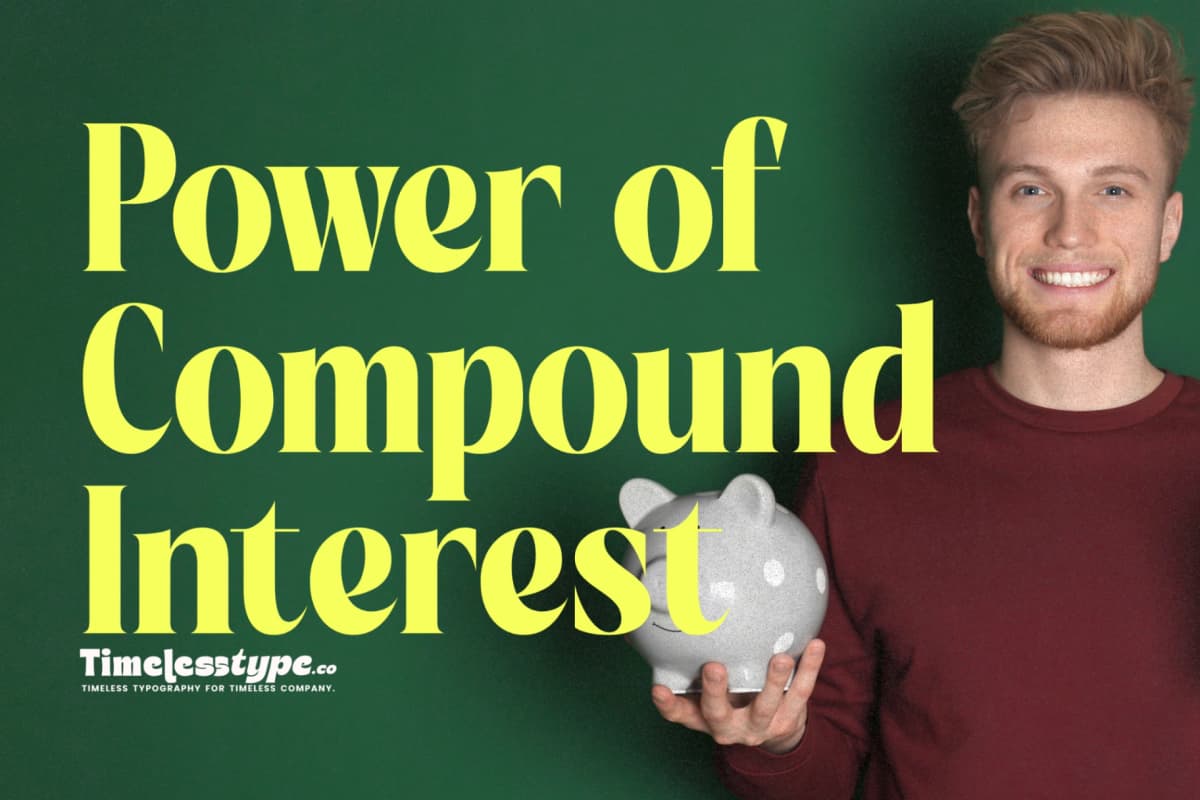
Table of Contents
- 1. What Is Compound Interest?
- Example:
- 2. The Formula Behind the Magic
- 3. The Real Secret: Time Over Amount
- Scenario 1: The Early Saver
- Scenario 2: The Late Saver
- 4. Compound Interest Works Both Ways
- Example:
- 5. The Rule of 72: Estimate Your Growth Easily
- Example:
- 6. Why Small Savings Matter More Than You Think
- Example:
- 7. Automate Your Compounding
- How to Automate Growth:
- 8. Reinvest, Don’t Withdraw Early
- 9. Inflation: The Silent Enemy of Growth
- Example:
- 10. Start Early — But It’s Never Too Late
- 11. Real-Life Examples of Compounding in Action
- Example 1: The Investor Who Started Early
- Example 2: The Investor Who Waited
- 12. Avoid These Common Compounding Mistakes
- Mistake 1: Withdrawing Too Often
- Mistake 2: Ignoring Debt
- Mistake 3: Chasing High Returns
- Mistake 4: Not Reviewing Progress
- 13. Compounding Beyond Money
- 14. How to Start Today
- Simple Steps:
- 15. Final Thought: Time Is Your Greatest Asset
The Power of Compound Interest: How Small Savings Grow Big
There’s a simple, almost magical principle in personal finance that can turn small, consistent savings into a fortune over time.
It doesn’t require luck, high income, or risky investments — just patience and consistency.
That principle is called compound interest.
Albert Einstein once called it “the eighth wonder of the world.”
Why? Because those who understand it, earn it — and those who don’t, pay it.
Let’s explore what compound interest really is, why it’s so powerful, and how you can use it to build wealth — even starting small.
1. What Is Compound Interest?
Compound interest is interest on your interest.
In simple terms, it means your money grows not just on your initial amount (principal), but also on the interest that accumulates over time.
This creates a snowball effect — the longer your money stays invested, the faster it grows.
Example:
Let’s say you invest $1,000 with an annual interest rate of 10%.
After 1 year, you’ll have $1,100.
In the second year, you’ll earn interest on $1,100 — not just the original $1,000.
That means you’ll have $1,210 after year two.
By year 10, without adding anything else, that same $1,000 becomes $2,593.
That’s the power of compounding — time turns your money into a growth machine.
2. The Formula Behind the Magic
The formula for compound interest is simple:
A = P (1 + r/n)ⁿᵗ
Where:
A = the final amount
P = principal (the starting amount)
r = annual interest rate (in decimal form)
n = number of times interest is compounded per year
t = time in years
Don’t worry if math isn’t your thing.
What matters most is understanding the key driver: time.
The longer your money compounds, the greater the growth — even if you never add another cent.
3. The Real Secret: Time Over Amount
When it comes to compound interest, time beats timing.
You don’t need to start with a lot — you just need to start early.
Scenario 1: The Early Saver
Anna invests $100 per month starting at age 25.
She stops investing after 10 years — total contribution: $12,000.
Her investment grows at 8% annually.
By the time she’s 65, her money grows to $150,000.
Scenario 2: The Late Saver
Ben starts investing at 35, contributing $100 per month for 30 years (total $36,000).
Same 8% growth rate.
By 65, Ben’s investment grows to $135,000.
Even though Anna saved less money for less time, she ends up with more — simply because she started earlier.
Lesson:
The best time to start saving was yesterday.
The second-best time is today.
4. Compound Interest Works Both Ways
Compounding is powerful — but it’s neutral.
It works for you when you save or invest.
But it works against you when you owe money.
Example:
If you carry a $5,000 credit card balance with 20% annual interest and only pay the minimum, compounding turns that into $10,000+ in just a few years.
That’s why compounding is called a “double-edged sword.”
The choice is simple:
Either use it to grow wealth — or let it grow your debt.
5. The Rule of 72: Estimate Your Growth Easily
Want a quick way to estimate how long it takes for your money to double?
Use the Rule of 72.
Just divide 72 by your annual interest rate.
Example:
At 6% interest → 72 ÷ 6 = 12 years to double your money.
At 8% interest → 72 ÷ 8 = 9 years.
At 10% interest → 72 ÷ 10 = 7.2 years.
This simple rule shows how even small increases in return can make a huge difference over time.
6. Why Small Savings Matter More Than You Think
People often say, “I’ll start saving when I earn more.”
But waiting kills compounding.
Even small, consistent savings add up dramatically.
Example:
If you save $5 per day (the price of a coffee) and invest it at 8% annual return:
In 10 years → $27,000
In 20 years → $66,000
In 30 years → $150,000
A daily habit can turn into a lifetime of wealth.
It’s not about the size of your savings — it’s about your consistency.
“Do not save what is left after spending; spend what is left after saving.” — Warren Buffett
7. Automate Your Compounding
The best way to make compound interest work for you is to make it automatic.
How to Automate Growth:
Set up automatic transfers to your savings or investment account each payday.
Contribute regularly to a retirement fund (401k, IRA, or mutual fund).
Reinvest dividends and interest instead of cashing them out.
Automation removes the emotional friction of saving.
You build wealth quietly, consistently — without relying on willpower.
8. Reinvest, Don’t Withdraw Early
When you withdraw money from your savings or investment, you interrupt the compounding cycle.
Every dollar you pull out is a soldier that stops fighting for you.
Let your money stay invested and reinvest your returns.
Think long-term.
The longer you let it grow, the more exponential the results.
Pro Tip: Compounding doesn’t reward impatience — it rewards commitment.
9. Inflation: The Silent Enemy of Growth
While compounding builds wealth, inflation slowly erodes its value.
That’s why saving money in a low-interest account isn’t enough.
Example:
If inflation is 3% and your bank savings rate is 1%, your money is actually losing purchasing power every year.
To truly benefit from compounding, invest in assets that outpace inflation — like mutual funds, index funds, or stocks.
The goal isn’t just to grow money — it’s to grow real wealth that maintains value over time.
10. Start Early — But It’s Never Too Late
Yes, starting early gives you a huge advantage.
But even if you’re in your 30s, 40s, or 50s, it’s still worth starting now.
The power of compounding doesn’t vanish — it just adjusts.
The key is consistency and discipline.
If you start later, you can compensate by:
Saving more aggressively.
Investing in higher-return assets (with calculated risk).
Avoiding unnecessary withdrawals.
Remember: the best time to start was yesterday.
The second-best time is right now.
11. Real-Life Examples of Compounding in Action
Example 1: The Investor Who Started Early
Sara invests $200/month starting at age 25, with an 8% return.
At 65, she’ll have $622,000.
Example 2: The Investor Who Waited
Jake waits until 35 to start, investing the same $200/month.
At 65, he’ll have $295,000.
Sara only invested 10 years longer — but ends up with more than double.
That’s the magic of time + compounding.
12. Avoid These Common Compounding Mistakes
Even though compounding works naturally, beginners often sabotage their own growth.
Mistake 1: Withdrawing Too Often
Treating investments like short-term savings kills the effect of compounding.
Let your money stay invested.
Mistake 2: Ignoring Debt
If your debt interest is higher than your investment return, you’re moving backward.
Pay off high-interest loans first.
Mistake 3: Chasing High Returns
Greed can destroy years of growth.
Choose sustainable, consistent investments over quick wins.
Mistake 4: Not Reviewing Progress
Check your portfolio annually to adjust for inflation, risk tolerance, and goals.
13. Compounding Beyond Money
Compound interest isn’t just about finance — it’s a metaphor for life.
Small, consistent actions compound into massive results over time.
Reading 10 pages daily = hundreds of books over a decade.
Learning one skill per year = mastery over time.
Investing in health and relationships = lifelong dividends.
Growth, in any form, is exponential when done consistently.
That’s the real secret behind compounding — consistency over intensity.
14. How to Start Today
You don’t need to be rich to start investing — you just need to start.
Simple Steps:
Open a high-interest savings or investment account.
Automate a small amount weekly or monthly.
Reinvest dividends and interest.
Increase contributions gradually.
Be patient — and don’t panic during market dips.
Wealth grows quietly in the background when you stay consistent.
“Someone is sitting in the shade today because someone planted a tree a long time ago.” — Warren Buffett
15. Final Thought: Time Is Your Greatest Asset
The power of compound interest is not in complexity — it’s in time.
The longer you give your money (and habits) to grow, the greater your reward.
You don’t have to start big — you just have to start early, stay consistent, and let patience do the heavy lifting.
Because money doesn’t grow from magic — it grows from discipline, decisions, and time.
And the earlier you start, the more powerful the compounding becomes.
So start today.
Not because you must — but because your future self deserves it.
Related
Tags
Browse similar work by purpose and style.
.webp&w=1200&q=75)
.webp&w=1200&q=75)
.webp&w=1200&q=75)
.webp&w=1200&q=75)
.webp&w=1200&q=75)
.webp&w=1200&q=75)
.webp&w=1200&q=75)
.webp&w=1200&q=75)