
Business
The Impact of AI on Business Operations in 2025
Insights, tutorials, and type notes from the Timeless Type studio.
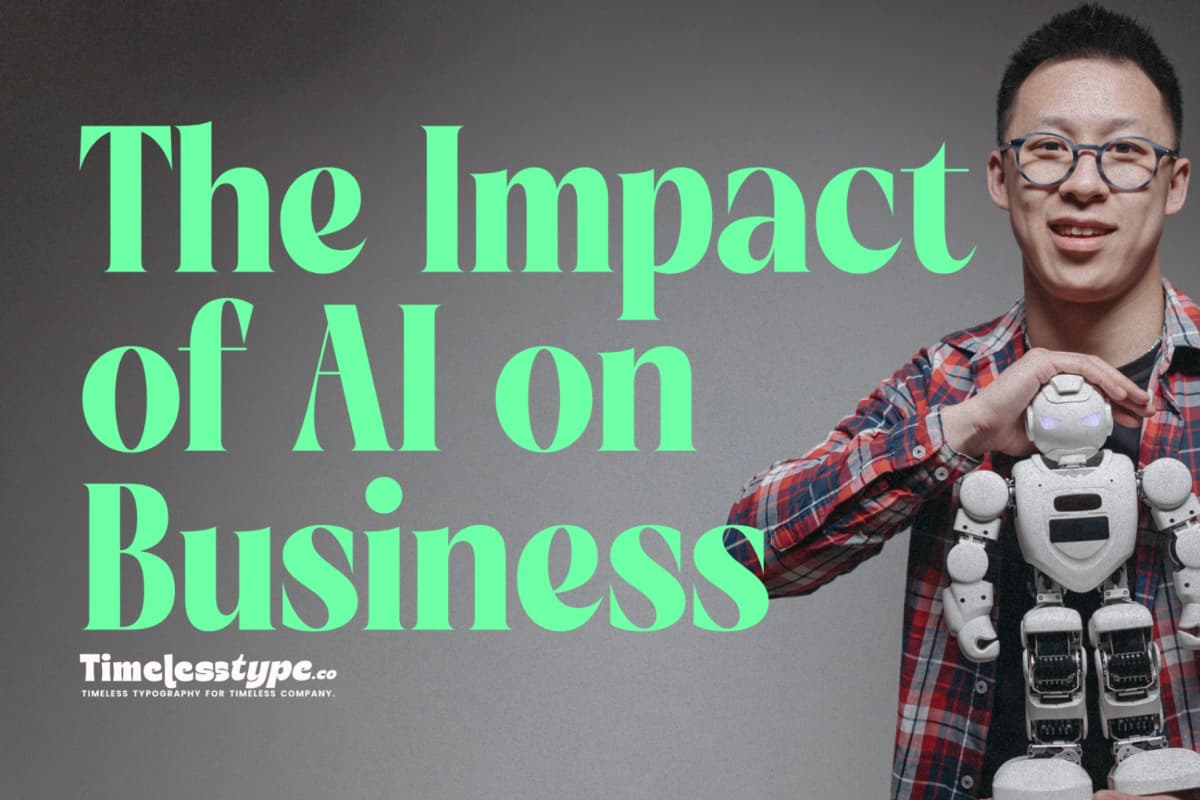
Table of Contents
- Executive Summary
- 1. The 2025 AI Landscape — What’s Changed
- 2. Key Operational Areas Transformed by AI
- a) Supply Chain & Procurement
- b) Finance & Accounting
- c) Customer Service & Experience
- d) Sales & Marketing
- e) Human Resources
- f) IT, Engineering, and Product
- 3. The New Playbook for AI Adoption
- 4. Measuring ROI in the AI Era
- 5. Governance and Security Framework
- Key Pillars
- 6. Build vs. Buy: Making the Right Choice
- 7. People and Process Transformation
- New Roles Emerging
- Organizational Shifts
- 8. 12-Month Implementation Roadmap
- 0–3 Months: Foundations & Quick Wins
- 3–6 Months: Scale What Works
- 6–12 Months: Industrialize
- 9. Case Studies Snapshot
- 10. Common Pitfalls to Avoid
- 11. The Executive’s Checklist
- 12. The New Reality: AI as the Business Operating System
The Impact of AI on Business Operations in 2025
Executive Summary
Artificial Intelligence (AI) has moved from being a promising technology to becoming the operating core of modern enterprises.
In 2025, AI is not just a tool for automation — it is a strategic enabler that drives efficiency, accuracy, and speed across every operational layer.
Key impacts:
20–40% increase in productivity on repetitive tasks
50–80% reduction in manual errors
3–10x faster decision cycles
25–30% cost savings on operations
AI is now embedded in finance, supply chain, HR, IT, and customer operations, redefining how value is created and delivered.
1. The 2025 AI Landscape — What’s Changed
Functional Copilots Everywhere
Every department now uses AI copilots — from Finance Copilot (automated reconciliation and report narratives) to Sales Copilot (customer insights, pitch generation) and Legal Copilot (contract redlining).
Autonomous Agents
AI agents handle multi-step workflows end-to-end — such as vendor communication, purchase order validation, or claim processing — with minimal human oversight.
AI Ops
In IT and DevOps, AI correlates logs, metrics, and traces to automatically identify, explain, and resolve incidents.
Enterprise Knowledge Graphs
RAG (Retrieval-Augmented Generation) and semantic search now turn decades of documents into intelligent, queryable knowledge.
Document-to-Workflow Automation
Intelligent document processing combined with LLMs converts unstructured inputs (invoices, forms, contracts) directly into system actions.
AI Governance Becomes Non-Negotiable
Guardrails, prompt logging, model evaluation, and bias detection are now built-in governance standards, not optional add-ons.
2. Key Operational Areas Transformed by AI
a) Supply Chain & Procurement
Demand Forecasting: AI combines internal sales data with external factors (weather, promotions, social signals) — reducing forecast errors by 25%.
Supplier Sourcing: Autonomous agents evaluate vendor performance and negotiate dynamically.
Inventory Optimization: Real-time tracking and prediction cut holding costs and waste.
KPIs: Forecast accuracy, inventory turns, OTIF (on-time in full), purchase cost variance.
b) Finance & Accounting
Faster Month-End Closing: Auto-reconciliation, anomaly detection, and narrative generation shorten close cycles by 4–6 days.
Fraud Detection: Pattern analysis identifies irregular transactions before they escalate.
FP&A Acceleration: AI runs scenario modeling and variance analysis automatically.
KPIs: Days to close, forecast bias, cash conversion cycle, audit exceptions.
c) Customer Service & Experience
Intelligent Self-Service: RAG-driven chatbots resolve up to 60% of L1 queries instantly.
Quality Assurance: 100% of calls are automatically reviewed for compliance and tone.
Predictive Service: AI predicts churn and suggests proactive retention actions.
KPIs: First Contact Resolution, CSAT/NPS, AHT (Average Handle Time), deflection rate.
d) Sales & Marketing
Lead Scoring and Outreach: AI analyzes customer intent signals and automates personalized messaging.
Content Generation: LLMs produce consistent, brand-aligned copy at scale.
Revenue Forecasting: Predictive analytics refine pipeline health and sales forecasts.
KPIs: Win rate, lead-to-customer conversion, CAC/LTV ratio, forecast accuracy.
e) Human Resources
Talent Acquisition: AI filters resumes fairly, drafts job descriptions, and supports structured interviews.
Employee Support: AI copilots handle FAQs, leave requests, and benefit inquiries.
Personalized Learning: Adaptive L&D platforms recommend micro-learning paths.
KPIs: Time-to-hire, employee engagement, internal mobility, retention rate.
f) IT, Engineering, and Product
Developer Productivity: AI-assisted coding speeds delivery by 30–40%.
Incident Management: AI Ops detect, classify, and fix issues automatically.
Security Operations: AI triages alerts, detects anomalies, and prioritizes threats.
KPIs: MTTR (Mean Time to Resolve), defect escape rate, deployment frequency, change lead time.
3. The New Playbook for AI Adoption
Start with Process, Not Model. Identify 5–10 high-cost, high-volume workflows (invoice intake, L1 support, demand planning).
Combine RAG + Workflow Orchestration. Blend retrieval, tool-calling, and automation pipelines.
Data Contracts First. Define data quality, schema, lineage — treat data as a product.
Human-in-the-Loop (HITL). Keep people at decision points where risk or regulation is high.
Evaluate and Iterate. Use real metrics (accuracy, efficiency, error rate) — not demo success.
4. Measuring ROI in the AI Era
Avoid vanity metrics like “hours saved.” Focus on business outcomes:
DimensionMetricProductivityThroughput, SLA compliance, process cycle timeQualityError rate, rework percentageDecision SpeedData-to-decision lead timeFinancial ImpactCost-to-serve, margin improvementRisk ReductionCompliance incidents, audit findings
ROI Formula:
(Operational savings + revenue uplift + risk cost avoided – AI investment) ÷ AI investment
5. Governance and Security Framework
AI governance is now a corporate mandate.
Key Pillars
Data Privacy: PII masking, consent management, and minimal exposure.
Model Governance: Catalog every model’s purpose, risk score, and evaluation results.
Prompt & Output Logging: Maintain audit trails for every copilot and chatbot.
Red Teaming & Testing: Simulate misuse, hallucination, and bias scenarios regularly.
Vendor Oversight: Contracts with data processing clauses, compliance audits, and fallback guarantees.
“AI trust is earned through transparency, not promises.”
6. Build vs. Buy: Making the Right Choice
ScenarioRecommendationStandard processes (AP, HR FAQs, IT support)Buy off-the-shelf AI SaaS tools.Complex or differentiating workflows (pricing, product design)Build or compose in-house.Hybrid approach (most enterprises)Combine prebuilt copilots with a modular agent orchestration layer.
The winning strategy in 2025 is “compose, don’t reinvent.”
7. People and Process Transformation
AI doesn’t replace people — it redefines roles.
New Roles Emerging
AI Product Owner
AI Solution Architect
Data Product Manager
Prompt Engineer / Conversation Designer
AI Risk & Governance Lead
Organizational Shifts
Redesign SOPs for AI-assisted workflows.
Create exception playbooks and fallback protocols.
Incentivize teams on outcomes, not activity.
“AI won’t replace you. But someone who knows how to use AI will.”
8. 12-Month Implementation Roadmap
0–3 Months: Foundations & Quick Wins
Form an AI Council (Ops, IT, Risk, Legal).
Identify top 3 pilot use cases (invoice processing, support bot, AIOps).
Set data quality, gold documents, and evaluation standards.
Deploy MVP with human supervision.
3–6 Months: Scale What Works
Integrate successful pilots with core systems (ERP, CRM).
Expand automation scope; include regional or multilingual variants.
Add QA automation and continual learning loops.
Measure ROI and sunset legacy steps.
6–12 Months: Industrialize
Deploy multi-agent orchestration for end-to-end processes (Order-to-Cash, Procure-to-Pay).
Implement model routing (cost/performance/privacy optimization).
Upskill workforce; embed AI literacy in all functions.
Standardize governance, evaluation, and monitoring.
9. Case Studies Snapshot
FMCG Company (APAC) — Automated invoice intake and PO matching:
65% touchless processing (from 12%)
Close cycle reduced by 4 days
Audit exceptions down 70%
E-commerce Brand — Customer support RAG bot + auto-QA:
55% L1 deflection
AHT -28%
CSAT +8 points
Automotive Manufacturer — AIOps + Vision QC:
MTTR -42%
False rejects -35%
Shift output +11%
SaaS Company — Sales copilot:
Call prep time -60%
Win rate +6 p.p.
Forecast accuracy +14 p.p.
10. Common Pitfalls to Avoid
MistakeImpactStarting with flashy demos instead of real processesNo ROI or scalabilityUsing outdated documents in RAGMisinformation and user distrustAllowing shadow AIData leakage and compliance riskIgnoring post-deployment monitoringQuality degradation and cost creep
11. The Executive’s Checklist
Every AI project has a business owner and measurable KPI.
Data is clean, versioned, and verified.
Human oversight defined for high-risk decisions.
Governance guardrails active (PII, logging, testing).
Integration via secure APIs, not scrapers.
Continuous monitoring of performance, cost, and accuracy.
Change management and workforce training in place.
12. The New Reality: AI as the Business Operating System
By 2025, AI is not a plug-in — it’s the invisible backbone of modern operations.
It connects data, people, and systems into intelligent workflows that think, learn, and adapt.
The winners are not those who adopt AI fastest, but those who execute with discipline — balancing innovation with governance, and ambition with accountability.
“AI doesn’t just transform how we work.
It transforms what work means.”
Related
Tags
Browse similar work by purpose and style.
.webp&w=1200&q=75)
.webp&w=1200&q=75)
.webp&w=1200&q=75)
.webp&w=1200&q=75)

.webp&w=1200&q=75)
.webp&w=1200&q=75)
.webp&w=1200&q=75)