
Inspiration
The Art of Perseverance: Keep Going Even When It Gets Hard
Insights, tutorials, and type notes from the Timeless Type studio.
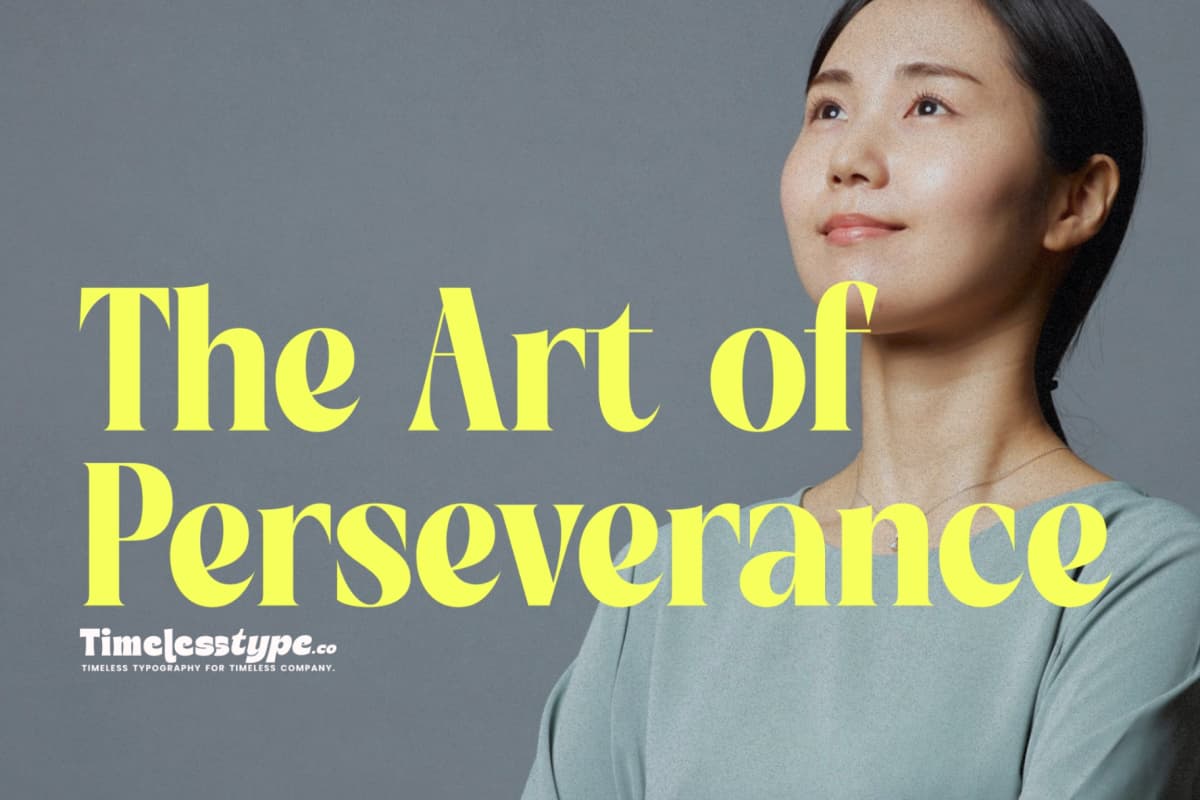
Table of Contents
- Introduction: When Life Tests You, It’s Not Punishment — It’s Proof
- 1. Understanding Perseverance — It’s Not About Never Falling
- 2. Why Perseverance Matters More Than Talent
- Here’s why perseverance is irreplaceable:
- 3. The Psychology Behind Perseverance
- 1️⃣ Purpose (Your “Why”)
- 2️⃣ Growth Mindset
- 3️⃣ Emotional Regulation
- 4. The Roadblocks: What Makes People Give Up
- 1️⃣ The Expectation of Quick Results
- 2️⃣ The Fear of Failure
- 3️⃣ The Weight of Comparison
- 4️⃣ Burnout
- 5. Turning Struggle Into Strength — The Process of Endurance
- Step 1: Accept the Reality
- Step 2: Focus on the Next Step, Not the Entire Journey
- Step 3: Reframe Pain as Data
- Step 4: Build a Routine Around Persistence
- Step 5: Celebrate Micro-Wins
- 6. Lessons From Those Who Kept Going
- 7. When to Rest, When to Push
- 8. Building Perseverance Daily — Habits That Make You Mentally Stronger
- 1️⃣ Embrace Discomfort Intentionally
- 2️⃣ Practice Gratitude
- 3️⃣ Keep a “Persistence Journal”
- 4️⃣ Surround Yourself With People Who Endure
- 5️⃣ Visualize the Long Game
- 9. The Emotional Side of Perseverance — Fighting the Inner Voice
- 10. The Role of Hope in Perseverance
- 11. Letting Go of the Need for Immediate Proof
- 12. The Spiritual Core of Perseverance — Becoming Bigger Than the Struggle
- 13. When You Feel Like You’re Failing, Remember This
- Conclusion: Keep Going — Even When It’s Just You
The Art of Perseverance: Keep Going Even When It Gets Hard
Introduction: When Life Tests You, It’s Not Punishment — It’s Proof
At some point, everyone hits a wall.
Maybe it’s exhaustion, heartbreak, failure, or silence where you expected applause.
You’ve done everything right — worked hard, stayed kind, kept showing up — and still, nothing seems to move.
It’s in those moments, when everything inside you whispers “give up,” that perseverance becomes art.
Because perseverance isn’t blind stubbornness.
It’s the quiet, disciplined act of continuing — especially when there’s no applause, no guarantees, and no clear finish line.
That’s what separates dreams from delusions, and achievers from almosts.
“Perseverance is not a long race; it is many short races one after another.” — Walter Elliot
1. Understanding Perseverance — It’s Not About Never Falling
Most people misunderstand perseverance. They think it means never quitting, never breaking, or never doubting.
But that’s not humanly possible.
Real perseverance is not about avoiding failure; it’s about continuing despite failure.
It’s resilience in motion — the ability to bend but not break, to pause but not stop.
Perseverance doesn’t demand perfection.
It asks for one simple thing: get up one more time than you fall.
2. Why Perseverance Matters More Than Talent
Talent opens doors. Perseverance walks through them.
You can have intelligence, resources, or even luck — but without persistence, they fade.
Here’s why perseverance is irreplaceable:
Consistency compounds. Small, repeated actions turn into unstoppable momentum.
Discipline outlasts motivation. Feelings fade; habits remain.
Resilience attracts opportunity. The world rewards those who endure, not those who start strong and stop early.
“Nothing in the world can take the place of persistence.” — Calvin Coolidge
Talent makes you promising.
Perseverance makes you unforgettable.
3. The Psychology Behind Perseverance
Behind every story of grit lies the same psychological pattern — a mix of purpose, mindset, and emotional endurance.
1️⃣ Purpose (Your “Why”)
People who persevere don’t just chase goals — they chase meaning.
A strong why keeps you going when how becomes unclear.
Ask yourself:
Why does this matter to me?
Who am I doing this for?
What’s at stake if I give up?
A clear purpose turns obstacles into checkpoints, not dead ends.
2️⃣ Growth Mindset
Coined by psychologist Carol Dweck, a growth mindset believes that ability is not fixed — it’s developed.
When you view challenges as opportunities to learn, failure stops being fatal.
Instead of saying,
“I can’t do this,”
you learn to say,
“I can’t do this yet.”
That one word — yet — is the language of perseverance.
3️⃣ Emotional Regulation
Perseverance isn’t purely willpower; it’s emotional management.
You can’t fight for long if you burn out in the first round.
Learn to rest without quitting.
Step back, breathe, reset — then continue.
That’s not weakness. That’s strategy.
4. The Roadblocks: What Makes People Give Up
Let’s be honest — perseverance is hard because pain is persuasive.
Here are the real reasons people stop:
1️⃣ The Expectation of Quick Results
We live in an instant world — instant delivery, instant validation, instant progress.
But growth doesn’t work like that.
The longer something takes, the more valuable it usually becomes.
2️⃣ The Fear of Failure
Failure isn’t fatal; avoidance is.
The longer you avoid trying, the more fear grows.
Action shrinks fear — always.
3️⃣ The Weight of Comparison
Looking sideways kills momentum.
Everyone’s chapter 20 looks better than your chapter 2.
Run your race — not theirs.
4️⃣ Burnout
You can’t pour from an empty cup.
Perseverance without balance becomes punishment.
Even warriors rest between battles.
5. Turning Struggle Into Strength — The Process of Endurance
You can’t control what happens, but you can control how you continue.
Here’s how perseverance works in practice:
Step 1: Accept the Reality
Don’t sugarcoat hardship. Acknowledge it.
Suffering denied becomes suffering doubled.
Step 2: Focus on the Next Step, Not the Entire Journey
When the mountain feels impossible, just take one step. Then another.
Progress doesn’t require speed — only direction.
Step 3: Reframe Pain as Data
Instead of saying, “Why is this happening to me?”, ask, “What is this teaching me?”
Pain becomes fuel when it carries purpose.
Step 4: Build a Routine Around Persistence
Habits are anchors when motivation fades.
Structure your days so discipline carries you when inspiration doesn’t.
Step 5: Celebrate Micro-Wins
Every small victory is proof you’re still in the fight.
Honor progress, no matter how small — because persistence is built, not declared.
6. Lessons From Those Who Kept Going
History is full of people who turned rejection into revolution — not because they never failed, but because they refused to stop.
J.K. Rowling was rejected by 12 publishers before Harry Potter changed the world.
Thomas Edison failed over 1,000 times before inventing the lightbulb.
Nelson Mandela spent 27 years in prison — and came out leading a nation toward unity.
Colonel Sanders heard “no” over 1,000 times before KFC became a global brand.
Each story shares the same plotline:
Rejection didn’t define them. Response did.
“The difference between the impossible and the possible lies in a person’s determination.” — Tommy Lasorda
7. When to Rest, When to Push
Perseverance isn’t about grinding until you collapse. It’s about knowing when to pause and when to press on.
Ask yourself:
Am I exhausted or unmotivated?
Do I need a break or a change in direction?
Am I quitting because it’s hard, or because it’s wrong for me?
Rest is not quitting.
Refocusing is not failure.
True perseverance is flexible — it adapts without surrendering.
8. Building Perseverance Daily — Habits That Make You Mentally Stronger
Perseverance isn’t born in big moments — it’s built in small ones.
Here are practical ways to cultivate it:
1️⃣ Embrace Discomfort Intentionally
Do something hard every day — a cold shower, a difficult workout, a tough conversation.
Discomfort is a muscle. Train it.
2️⃣ Practice Gratitude
It rewires your brain for optimism and resilience.
Grateful people don’t ignore pain — they find strength within it.
3️⃣ Keep a “Persistence Journal”
Each day, write one thing you overcame — no matter how small.
Seeing your progress on paper strengthens belief.
4️⃣ Surround Yourself With People Who Endure
Energy is contagious.
Find those who persist despite pain — they’ll remind you how strong you are.
5️⃣ Visualize the Long Game
When things get hard, picture your future self thanking you for not quitting today.
9. The Emotional Side of Perseverance — Fighting the Inner Voice
Sometimes, the hardest battle is internal.
That quiet voice saying, “You’re not good enough,” “It’s too late,” “You’ll never make it.”
Here’s the truth:
Those thoughts don’t mean you’re weak. They mean you’re human.
But perseverance answers them differently:
“I don’t need to be the best. I just need to begin.”
“It’s not too late. It’s just not easy.”
“I may not have everything, but I still have myself — and that’s enough to start.”
“Courage doesn’t mean you don’t get afraid. Courage means you don’t let fear stop you.” — Bethany Hamilton
10. The Role of Hope in Perseverance
Hope is not passive optimism — it’s active belief.
It’s the voice that says, “I don’t know how this ends, but I’m not done yet.”
Hope fuels endurance because it gives pain a purpose.
Without it, effort feels empty.
So when you’re tired, stop looking for motivation — look for meaning.
Why does this matter? What does it build? Who will it serve?
That’s where hope lives. That’s where perseverance is born again.
11. Letting Go of the Need for Immediate Proof
One of the hardest parts of perseverance is continuing without validation.
You may not see results for months, maybe years.
But unseen progress is still progress.
Seeds grow in darkness long before they bloom in light.
Trust that your effort is doing its work — even when the world hasn’t noticed yet.
You’re not behind. You’re becoming.
12. The Spiritual Core of Perseverance — Becoming Bigger Than the Struggle
At its deepest level, perseverance isn’t just about achieving something.
It’s about who you become in the process.
The struggle strips away pride, fear, and illusion — leaving behind the part of you that can’t be broken.
You stop asking for easy roads. You start asking for stronger legs.
Perseverance turns suffering into strength, and strength into wisdom.
“The oak fought the wind and was broken, the willow bent when it must and survived.” — Robert Jordan
13. When You Feel Like You’re Failing, Remember This
Progress rarely feels like progress.
Success is just persistence after many boring, silent days.
No one ever regrets trying one more time — only giving up too soon.
Perseverance isn’t about grand victories.
It’s about the small, unglamorous act of showing up — again and again, until the tide turns.
And when it finally does, you’ll realize: the process didn’t just lead to your goal — it built the person who could handle it.
Conclusion: Keep Going — Even When It’s Just You
There will be seasons when no one believes in you.
When the applause fades. When progress feels invisible.
That’s where perseverance becomes sacred — when you keep walking, not because of recognition, but because of conviction.
Keep going when it’s hard.
Keep going when it’s slow.
Keep going when it feels meaningless — because one day, it won’t be.
You’ll look back and see every detour, delay, and doubt as part of your design.
That’s the art of perseverance — not forcing life to go your way, but trusting that every step, no matter how painful, still moves you forward.
Related
Tags
Browse similar work by purpose and style.
.webp&w=1200&q=75)
.webp&w=1200&q=75)
.webp&w=1200&q=75)
.webp&w=1200&q=75)
.webp&w=1200&q=75)

.webp&w=1200&q=75)
.webp&w=1200&q=75)