


.jpg&w=256&q=75&dpl=dpl_Gc2H6qw5qz6tftmNLm7EMoaFVtW7)
.jpg&w=256&q=75&dpl=dpl_Gc2H6qw5qz6tftmNLm7EMoaFVtW7)
.webp&w=256&q=75&dpl=dpl_Gc2H6qw5qz6tftmNLm7EMoaFVtW7)
.webp&w=256&q=75&dpl=dpl_Gc2H6qw5qz6tftmNLm7EMoaFVtW7)



Technology
Artificial Intelligence in 2025: How AI is Transforming Business, Work, and Everyday Life
Insights, tutorials, and type notes from the Timeless Type studio.
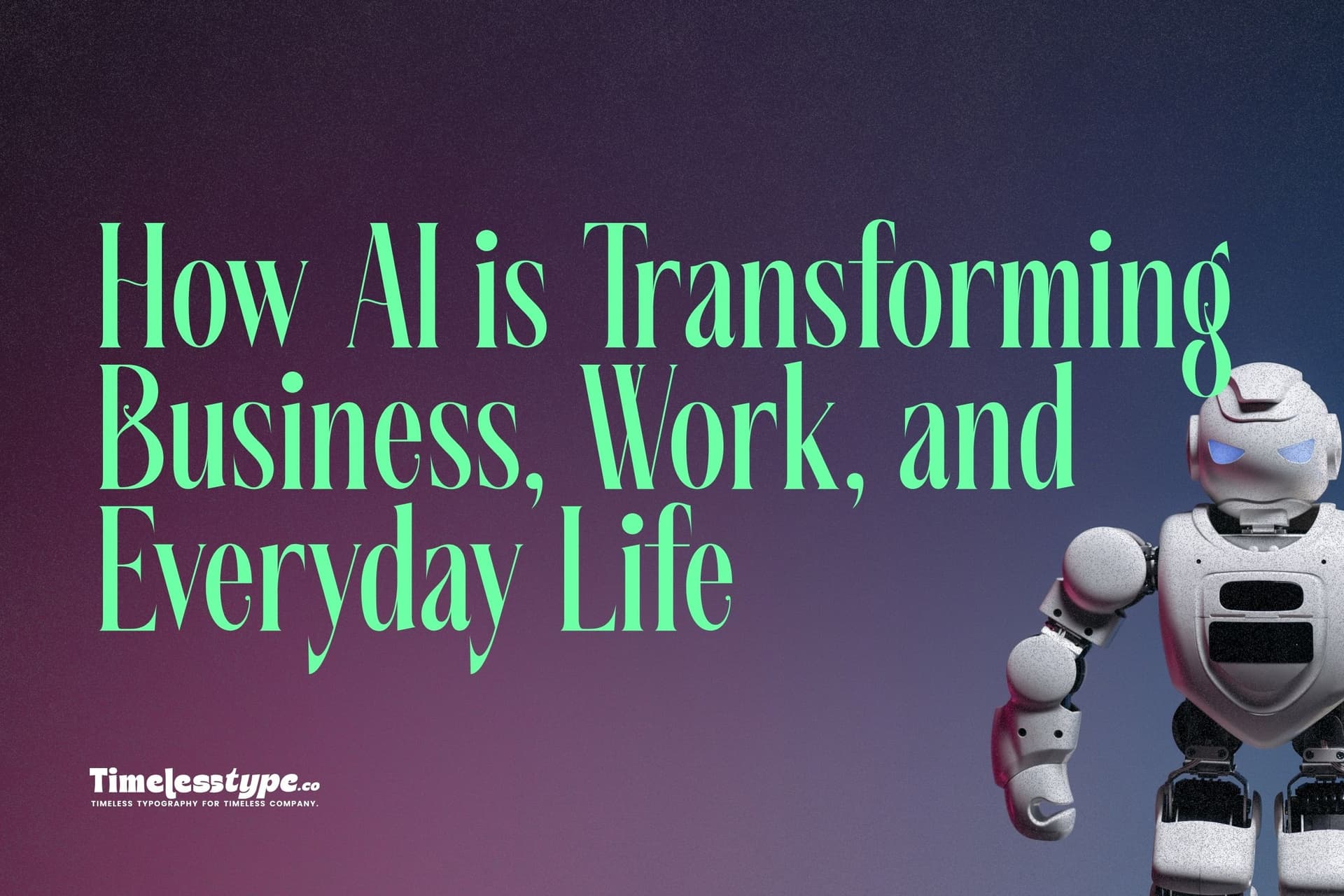
Table of Contents
Artificial Intelligence in 2025: How AI is Transforming Business, Work, and Everyday Life
Introduction
Artificial Intelligence (AI) has moved from science fiction to everyday reality. In 2025, AI is not just powering tech companies but also shaping how businesses, governments, and individuals operate. From virtual assistants and automation to medical breakthroughs and personalized education, AI is redefining the way we live and work.
This article explores the state of AI in 2025, how it’s transforming industries, the opportunities it brings, and the challenges we must address.
What is Artificial Intelligence?
AI refers to computer systems designed to perform tasks that typically require human intelligence — learning, problem-solving, understanding language, and making decisions. It includes:
Machine Learning (ML) – Systems that learn from data patterns.
Natural Language Processing (NLP) – Understanding and generating human language.
Computer Vision – Recognizing images and video.
Generative AI – Creating text, music, art, or designs from algorithms.
AI Trends in 2025
Generative AI Expansion
Tools like ChatGPT, MidJourney, and Suno AI have made content creation easier than ever. Businesses use generative AI for marketing, product design, and entertainment.
AI-Powered Automation
Routine office tasks, customer service, and data analysis are increasingly automated, freeing humans for strategic work.
Healthcare Revolution
AI assists in diagnostics, drug discovery, and personalized treatment plans, making healthcare more efficient and accessible.
Education Personalization
Adaptive learning platforms adjust lessons to each student’s pace and style.
AI in Finance
From fraud detection to robo-advisors, AI enhances security and investment decision-making.
AI + IoT Integration
Smart homes and cities powered by AI and connected devices create more efficient lifestyles.
Benefits of AI in 2025
Efficiency – Automates repetitive work and reduces human error.
Cost Savings – Businesses save time and money.
Innovation – Unlocks new products, services, and experiences.
Accessibility – Makes services (healthcare, education) more inclusive.
Decision Support – Data-driven insights improve strategies.
Challenges and Risks of AI
Job Displacement – Automation may replace roles in manufacturing, data entry, and customer support.
Bias and Fairness – AI systems can inherit human biases from data.
Privacy Concerns – AI requires vast amounts of personal data, raising ethical issues.
Security Threats – Deepfakes, AI-powered scams, and cyberattacks are rising.
Over-Reliance – Depending too much on AI could reduce critical human skills.
How AI is Changing Industries
Business
Marketing personalization.
Chatbots for customer support.
Predictive analytics for sales.
Healthcare
Early disease detection with AI imaging.
Virtual health assistants.
Accelerated drug development.
Education
AI tutors and adaptive e-learning.
Automated grading and feedback.
VR + AI for immersive learning.
Finance
AI-based fraud detection.
Robo-advisors for investment planning.
Risk assessment for loans and credit.
Lifestyle
Smart homes that learn user habits.
AI-driven fitness and wellness apps.
AI companions for mental health support.
Tips for Using AI Effectively in 2025
Stay Educated – Learn the basics of AI tools relevant to your field.
Combine Human + AI – Use AI for efficiency but add human creativity and ethics.
Secure Your Data – Protect personal and business data when using AI apps.
Experiment and Innovate – Try AI tools for content creation, design, or productivity.
Think Long-Term – Consider how AI can evolve with your business or career path.
Conclusion
AI in 2025 is no longer futuristic — it’s a reality shaping every industry and aspect of daily life. From business growth and medical advances to smarter homes and personalized education, the opportunities are vast.
At the same time, challenges like job shifts, bias, and privacy demand responsible use. The key to success is balancing innovation with ethics while embracing AI as a powerful partner in progress.
Related
Tags
Browse similar work by purpose and style.
.webp&w=1920&q=75&dpl=dpl_Gc2H6qw5qz6tftmNLm7EMoaFVtW7)
.webp&w=1920&q=75&dpl=dpl_Gc2H6qw5qz6tftmNLm7EMoaFVtW7)
.webp&w=1920&q=75&dpl=dpl_Gc2H6qw5qz6tftmNLm7EMoaFVtW7)
.webp&w=1920&q=75&dpl=dpl_Gc2H6qw5qz6tftmNLm7EMoaFVtW7)
.webp&w=1920&q=75&dpl=dpl_Gc2H6qw5qz6tftmNLm7EMoaFVtW7)
.webp&w=1920&q=75&dpl=dpl_Gc2H6qw5qz6tftmNLm7EMoaFVtW7)
.webp&w=1920&q=75&dpl=dpl_Gc2H6qw5qz6tftmNLm7EMoaFVtW7)
.webp&w=1920&q=75&dpl=dpl_Gc2H6qw5qz6tftmNLm7EMoaFVtW7)